Thursday, February 18, 2021

seeds & Plants - Growing Flax & Producing Linen BUT not in 18C England

Step 6 - Breaking the Flax Stalks

Kathy King tells us in her 2006 article in the Quarterly Archives of the Tredyffrin Easttown (Pennsylvania) Historical Society that "when flax, a bast—or plant—fiber that grows about a yard high, is processed & woven it becomes linen. Linen was not produced in 18C England, since the country was very protective of its woolen industry. In an attempt to help Ireland become more prosperous, the British government decided to promote linen production there & provided tax incentives, tariffs, & encouraged artisans from continental Europe with linen skills to immigrate to Ireland. There was plenty of cheap labor in Ireland for the onerous chore of flax preparation & spinning. Ireland became the capital of British fine linen manufacturing.

"To grow flax you plow the land twice, plant seeds close together so it grows tall with little branching, hand weed it, and, when ripe, pull it—cutting it will discolor it & keep the fiber from being as long. It is back-breaking work. Then you dry it, remove the seeds, & rett it—submerge it in a pond for a couple of weeks so it rots & the fibers separate. Then you dry it again, use a flax break to pound it to loosen the bark & connective tissue, & then scutch it—use a wooden sword-like tool to strike against the fiber to remove the bark & connective tissue. Next you hackle [there are many ways this was spelled at that time; I have used the modern spelling] it by repeatedly drawing it through a tool with many long, sharp metal teeth that rids the flax of short fibers—the tow—and bark. Then it is spun. It's harder to spin flax than wool, as it's long & wiry."

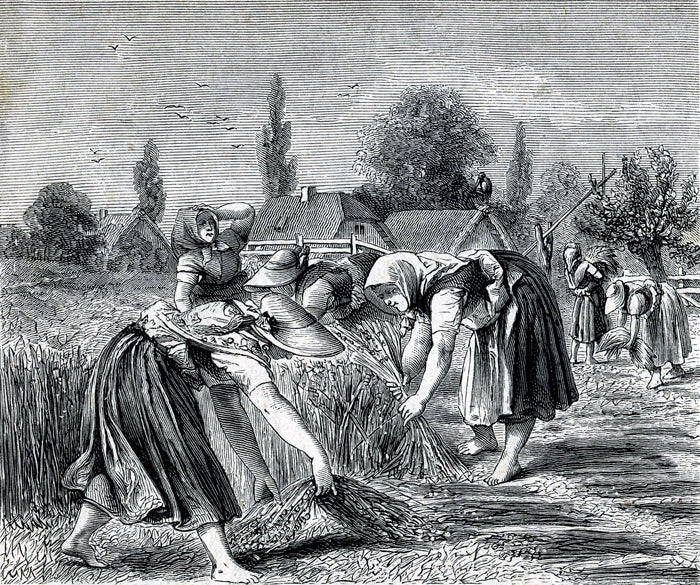
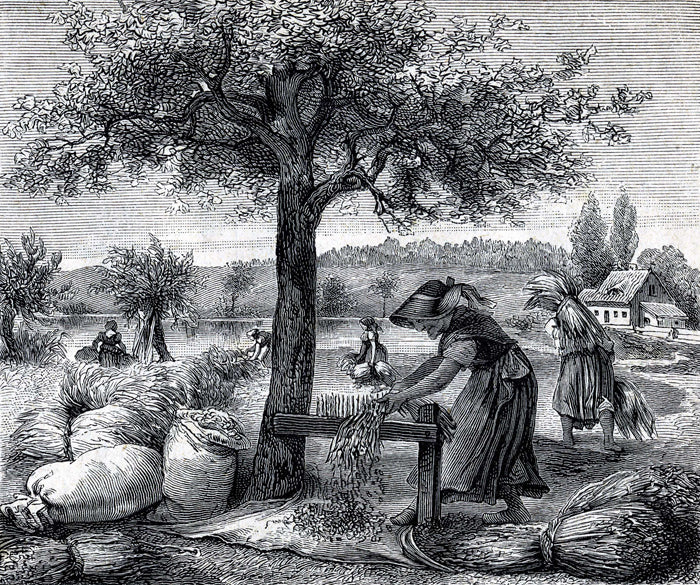
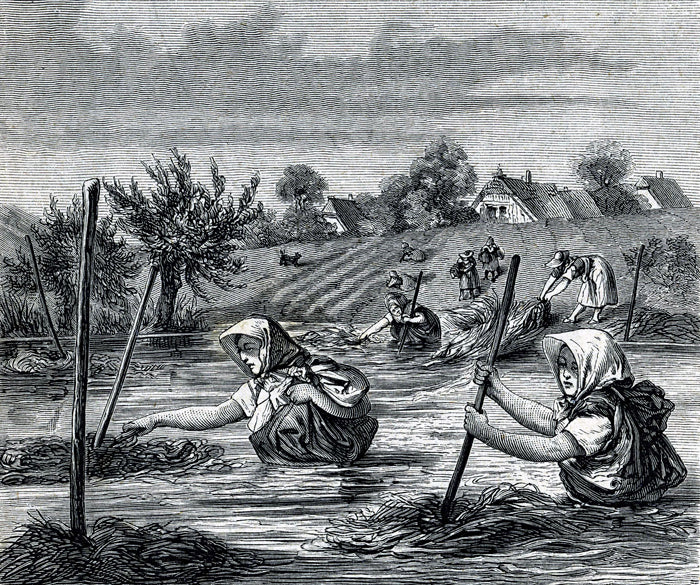
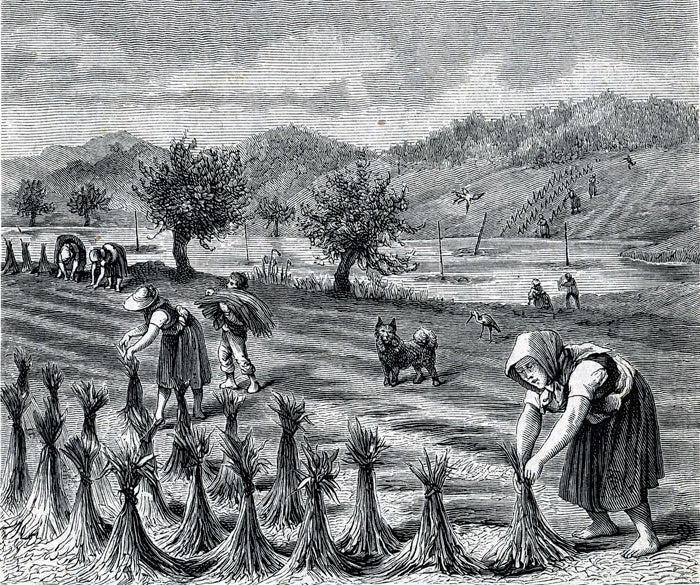
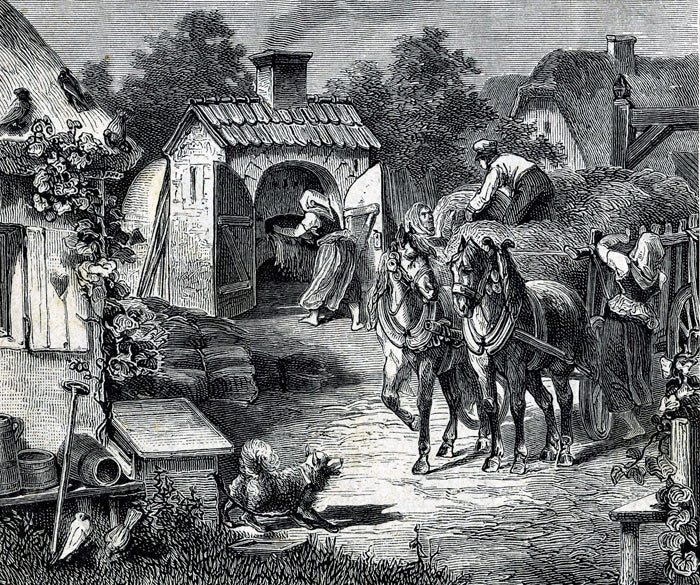
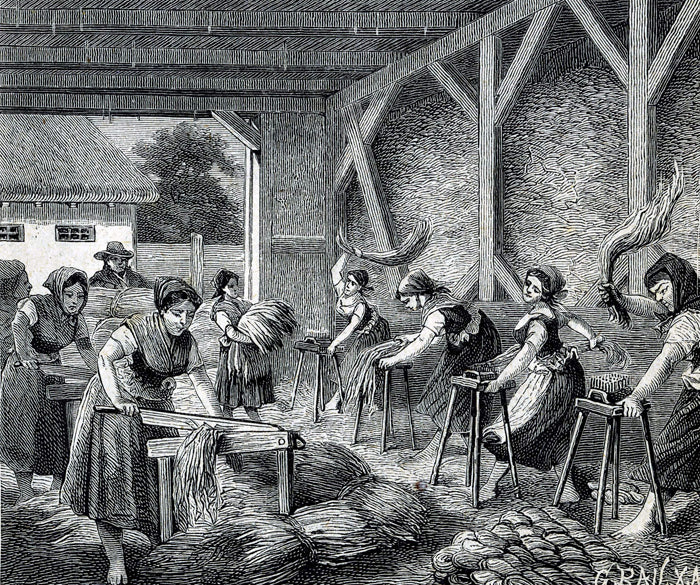
For European farm families, linen provided clothing and bedding as well as grain sacks and other items necessary for farm work. Most of the backbreaking work in making linen was performed by women, as portrayed in the pictures below, taken from a German Almanac published in 1882.

Step 1 - Pulling
Flax was sown in March or April. It was a fast growing plant that grew about 40 inches tall. Sometime during August, when the plants’ color turned to a golden hue, the plants were ready for harvest. In order to produce the best quality linen possible, the fiber had to be hand harvested by either pulling the whole plant by the root or by cutting the stalks very close to the ground.

Step 1 - Pulling the Flax

Step 2 - Separating
After the harvest, flax seeds were removed through a process called “rippling”. During this process the plant stalks were pulled through a rippling comb, which was an iron or wooden device that was studded with nails for the easy removal of seeds and other undesirable plant elements.

Step 2 - Separating the Flax from the Seeds

Step 3 - Retting
To dissolve the pectin, which binds the plant fibers together, the remaining flax stalks had to be rotted or “retted”. This could be achieved periodically, to allow the dew to accomplish the rotting process. A faster way to decompose the pectin was to submerge the stalks deep into the local pond and weigh them down with heavy objects, such as stones or logs. With this method, the retting took just a few days.

Step 3 - Retting the Flax Stalks

Step 4 - Drying
In late August or early September, after the plants were retted and retrieved, the farmers tied them into small bundles and laid them out in the open fields to dry. This was done to bring the rotting process of the fibers to an end. Retting the flax stalks too long would render them brittle and unsuitable for textile production.

Step 4 - Drying the Flax Bundles

Step 5 - Roasting
When the weather was damp, it was often necessary to roast the flax in special ovens at very low temperatures until it was dry.

Step 5 - Roasting the Flax

Step 6 - Breaking
After drying, the flax was ready for “scutching”, also called the “swinging” process. Small bundles of stalks were dragged in a swinging motion across a nail-spiked board to remove the woody parts of the fibers. At this time, only the long, soft flax strands remained, which were twisted into braids, ready to be spun. When the work was done, the young people of the village would meet for an evening of play and dance, the so-called “swing dances”.

Step 6 - Breaking the Flax Stalks

See: Quarterly Archives : Volume 43 of the Tredyffrin Easttown (Pennsylvania) Historical Society Real Colonial Women Don't Weave Cloth by Kathy King Source: Spring 2006 Volume 43 Number 2, Pages 62–70     

Tuesday, February 16, 2021

Garden Design - A Clump of Trees or Shrubs

Edward Savage, The East Front of Mount Vernon, c. 1787–92. Savage's paintings are the earliest known eyewitness views of the house &  grounds at Mount Vernon. (They date between 1787, when the Dove of Peace weathervane was added to the Mansion's cupola, &  1792, the year the outbuildings' roofs were repainted a Spanish brown color & the deer paddock near the East Lawn was removed.) The East Front portrays the bucolic setting of the Mansion.  Savage possibly stopped at Mount Vernon while traveling north from South Carolina in 1791 or 1792. 

A clump of trees or shrubs became a recognized garden component in the 2nd half of the 18C in both England & America. In British colonial America a clump usually was a group of 7 or 8 trees intentionally planted to form a single unit. England's The Complete Farmer (1769) suggested that these trees should be “without shape or order,” but Geographer Jedidiah Morse’s 1789 description of the “circular clumps” at Mount Vernon describes rounded, symmetrical groupings of trees as clumps. The Complete Farmer: Or, a General Dictionary of Husbandry is an 18C dictionary, dealing with most branches of agriculture. It contained various contemporary methods of cultivating and improving land plus information on breeding, managing, & fattening livestock. It was written by anonymous writers, which used the pseudonym a "Society of Gentlemen," only revealing that they were members of the Society for the Encouragement of Arts, the later Royal Society of Arts. The content was based on the insights of authorities in each field, which were listed as "Carl Linnaeus, Michel Lullin de Chateauvieux, Marquis de Turbilly, Hugh Plat, John Evelyn, John Worlidge, John Mortimer, Jethro Tull, Ellis, Philip Miller, Thomas Hale, Edward Lisle, Roque, John Mills, Arthur Young."

1800 Francis Jukes Jukes (American artist, 1745–1812)  Mount Vernon

George Washington noted March 2, 1785, at Mount Vernon, “Planted the remainder of the Ash Trees—in the Serpentine walks—the remainder of the fringe trees in the Shrubberies—all the black haws—all the large berried thorns with a small berried one in the middle of each clump—6 small berried thorns with a large one in the middle of each clump—all the swamp red berry bushes & one clump of locust trees.” Jedidiah Morse, noted of Mount Vernon in 1789, “...the lands in that side are laid out somewhat in the form of English gardens, in meadows & grass grounds, ornamented with little copses, circular clumps & single trees.”

The composition of clumps varied according to American observers. Bernard M’Mahon in 1806 stated that clumps could be composed solely of trees or shrubs, or a mixture of trees, shrubs, & herbaceous plants.  Clumps from a mixture of larger & smaller deciduous trees, such as the horse chestnut & red bud, were created at Monticello by Thomas Jefferson.

University of Virginia Architectural History Professor Richard Guy Wilson explains in his 2019 “Thomas Jefferson’s Architectural & Landscape Aesthetics: Sources &  Meaning” that "Jefferson certainly knew about the transformation that was taking place in the gardens of English country houses prior to his visit in 1786. On his own & then with Adams he visited many of the leading English picturesque gardens & observed firsthand the revolution. On the tour he took Thomas Whately’s Observations on Modern Gardening (1770) & saw the new composition that was in direct contrast to the highly organized, symmetrical gardens that dominated Versailles. Whatley describes this new English picturesque garden as an “exertion of fancy; a subject for taste” & “released now from the restraints of regularity, an enlarged beyond the purposes of domestic convenience, the most beautiful, the most simple, the most noble scenes of nature are all within its province.”  Influenced greatly by landscape painting of supposedly natural scenery, the new English mode attempted to create gardens that disavowed the hand of man. Instead of straight lines the paths were curved & sometimes followed the natural contours.  Ornate flower gardens disappeared except very close to the house & the landscape would be planted with clumps of trees & bushes that appeared random & not organized & ponds &  streams wandered through rather than encased in geometrical order. Of course, all of this “new style“...garden was created by man but with the intention of imitating nature."

West Front of Monticello and Garden, depicting Tho Jefferson's grandchildren at Monticello by Jane Braddick Peticolas, 1825.

Thomas Jefferson, wrote in his 1804 of Monticello's landscape plan, “The ground between the upper & lower roundabouts to be laid out in lawns & clumps of trees, the lawns opening so as to give advantageous catches of prospect to the upper roundabout...“The canvas at large must be Grove, of the largest trees, (poplar, oak, elm, maple, ash, hickory, chestnut, Linden, Weymouth pine, sycamore) trimmed very high, so as to give it the appearance of open ground, yet not so far apart but that they may cover the ground with close shade. This must be broken by clumps of thicket, as the open grounds of the English are broken by clumps of trees. plants for thickets are broom, calycanthus, altheas, gelder rose, magnolia glauca, azalea, fringe tree, dogwood, red bud, wild crab, kalmia, mezereon, euonymous, halesia, quamoclid, rhododendron, oleander, service tree, lilac, honeysuckle, brambles.”

Thomas Jefferson wrote of Bedford County VA retreat Poplar Forest, November 1812, that he had planted a “clump of Anthenian & Balsam poplars at each corner of house. intermix locusts, common & Kentucky, red-bud, dogwoods, calycanthus, liriodendron.”

In his 1770, Observations on Modern Gardening England's clump guru Thomas Whatley explains, “It has been already observed, that clumps differ only in extent from a wood, if they are close; or from a grove, if they are open...But besides the properties they may have in common with woods or with groves, they have others peculiar to themselves, which require examination.

“They are either independent or relative; when independent, their beauty, as single objects, is solely to be attended to; when relative, the beauty of the individuals must be sacrificed to the effect of the whole, which is the greater consideration.

“The least clump that can be, is of two trees; & the best effect they can have is, that their heads united should appear one large tree; two therefore of different species, or seven or eight of such shapes as do not easily join, can hardly be a beautiful group, especially if it have a tendency to a circular form. Such clumps of firs, though very common, are seldom pleasing; they do not compose one mass, but are only a confused number of pinnacles. The confusion is however avoided, by placing them in succession, not in clusters; & a clump of such trees is therefore more agreeable when it is extended rather in length than in breadth...

“If humbler growths at the extremity can discompose the strictest regularity, the use of it is thereby recommended upon other occasions. It is indeed the variety peculiarly proper for clumps: every apparent artifice affecting the objects of nature, disgusts; & clumps are such distinguished objects, so liable to the suspicion of having been left or placed on purpose to be so distinguished, that to divert the attention from these symptoms of art, irregularity in the composition is more important to them than to a wood or to a grove; being also less extensive, they do not admit so much variety of outline: but variety of growths is most observable in a small compass; & the several gradations may often be cast into beautiful figures.

“The extent & the outline of a wood or a grove engage the attention more than the extremities; but in clumps these last are of the most consequence: they determine the form of the whole; & both of them are generally in sight: great care should therefore be taken to make them agreeable & different. The ease with which they may be compared, forbids all similarity between them: for every appearance of equality suggests an idea of art; & therefore a clump as broad as it is long, seems less the work of nature than one which stretches into length.

“Another peculiarity of clumps, is the facility with which they admit a mixture of trees & of shrubs, of wood & of grove; in short, of every species of plantation. None are more beautiful than those which are so composed. Such compositions are, however, more proper in compact than in straggling clumps: they are most agreeable when they form one mass: if the transitions from very lofty to very humble growths, from thicket to open plantations, be frequent & sudden, the disorder ismore suited to rude than to elegant scenes.

“The occasions on which independent clumps may be applied, are many. They are often desirable as beautiful objects in themselves; they are sometimes necessary to break an extent of lawn, or a continued line, whether of ground or of plantation; but on all occasions a jealousy of art constantly attends them, which irregularity in their figure will not always alone remove. Though elevations shew them to advantage, yet a hillock evidently thrown up on purpose to be crowned with a clump, is artificial to a degree of disgust: some of the trees should therefore be planted on the sides,to take off that appearance. The same expedient may be applied to clumps placed on the brow of a hill, to interrupt its sameness: they will have less ostentation of design, if they are in part carried down either declivity. The objection already made to planting many along such a brow, is on the same principle: a single clump is less suspected of art; if it be an open one, there can be no finer situation for it, than just at the point of an abrupt hill, or on a promontory into a lake or a river. It is in either a beautiful termination, distinct by its position, & enlivened by an expanse of sky or of water, about & beyond it. Such advantages may ballance little defects in its form; but they are lost if other clumps are planted near it: art then intrudes, & the whole is displeasing...

“But though a multiplicity of clumps, when each is an independant object, seldom seems natural; yet a number of them may, without any appearance of art, be admitted into the same scene, if they bear a relation to each other: if by their succession they diversify a continued outline of wood; if between them they form beautiful glades; if all together they cast an extensive lawn into an agreeable shape, the effect prevents any scrutiny into the means of producing it. But when the reliance on that effect is so great, every other consideration must give way to the beauty of the whole. The figure of the glade, of the lawn, or of the wood, are principally to be attended to: the finest clumps, if they do not fall easily into the great lines, are blemishes: their connections, their contrasts, are more important than their forms.

“A line of clumps, if the intervals be closed by others beyond them, has the appearance of a wood, or of a grove; & in one respect the semblance has an advantage over the reality. In different points of view, the relations between the clumps are changed; & a variety of forms is produced, which no continued wood or grove, however broken, can furnish. These forms cannot all be equally agreeable; & too anxious a solicitude to make them every where pleasing, may, perhaps, prevent their being ever beautiful. The effect must often be left to chance; but it should be studiously consulted from a few principal points of view; & it is easy to make any recess, any prominence, any figure in the outline, by clumps thus advancing before, or retiring behind one another.

“But amidst all the advantages attendant on this species of plantation, it is often exceptionable when commanded from a neighboring eminence; clumps below the eye lose some of their principal beauties; & a number of them betray the art of which they are always liable to be suspected; they compose no surface of wood; & all effects arising from the relations between them are entirely lost. A prospect spotted with many clumps can hardly be great: unless they are so distinct as to be objects, or so distant as to unite into one mass, they are seldom an improvement of a view.”

A 1788 description of William Hamilton's The Woodlands near Philadelphia, PA noted clumps, “[The walks were] planted on each side with the most beautiful & curious flowers & shrubs. They are in some parts enclosed with the Lombardy poplar except here & there openings are left to give you a view of some fine trees or beautiful prospect beyond, & in others, shaded by arbours of the wild grape, or clumps of large trees under which are placed seats where you may rest yourself & enjoy the cool air.” And in 1806, Charles Drayton wrote of  The Woodlands, “The Approach, its road, woods, lawn & clumps, are laid out with much taste & ingenuity.”

James Peller Malcom (1767-1815), Woodlands, the Seat of W. Hamilton Esq., from the Bridge at Grey's Ferry, ca. 1792 Detail

England's Charles Marshall, in his 1st American edition of 1799 An Introduction to the Knowledge & Practice of Gardening explained, “As to small plantations, of thickets, coppices, clumps, & rows of trees, they are to be set close according to their nature, & the particular view the planter has, who will take care to consider the usual size they attain, & their mode of growth. An advantage at home for shade or shelter, & a more distant object of sight, will make a difference: for some immediate advantage, very close planting may take place, but good trees cannot be thus expected; yet if thinned in time, a strait tall stem is often thus procured, which afterwards is of great advantage.

“For little clumps, or groupes of forest trees, there may be planted three or four in a sport, within five or six feet of one another, & thus be easily fenced: having the air freely all round, & a good soil, such clumps produce fine timber. . .

“Rural & extensive gardening is naturally connected with a taste for planting forest trees; & an idea of the picturesque should ever accompany the work of planting. Merely for the sake of objects to gratify the eye, planting is very often pursued, & wherever trees can be introduced to improve a view from the house, or accustomed walks, there a man, having it in his power, a proprieter of the land, ought to plant.

“If to planting in clumps, coppices, groves, avenues, & woods, be added levelling of ground, improving of water courses, & pastures, making lawns, &c. the expense incurred would be honorable, & answered by pleasures of the sincerest kind! . . .

“If there is good room, single trees of the fir kind, at due distances, are admirable ornaments about a house, & clumps of shrubs all of the same kind have a good effect. . .

“Too much plain is to be guarded against, & when it abounds, the eye should be relieved, by clumps or some other agreeable object.”

William Russell Birch (1755-1834). Woodlands, the Seat of Mr. Wm. Hamilton, Pennsylvania, from Country Seats of the United States, 1808.

François Alexandre-Frédéric, duc de, La Rochefoucauld Liancourt, 1796, described Drayton Hall, plantation of John Drayton, Charleston, SC in 1796,“We stopped to dine with Dr. Drayton at Drayton-hall. The house is an ancient building, but convenient & good; & the garden is better laid out, better cultivated & stocked with good trees, than any I have hitherto seen. In order to have a fine garden, you have nothing to do but to let the trees remain standing here & there, or in clumps, to plant bushes in front of them, & arrange the trees according to their h eight. Dr. Drayton’s father, who was also a physician, began to lay out the garden on this principle; & his son, who is passionately fond of a country life, has pursued the same plan.”

P. E. Du Simitiére (1737-1784) Drayton Hall S.C

Washigton DC gardeners John Gardiner & David Hepburn, in the 1804 American Gardener, recommended the use of a graduated slope for such plantings. Their text was generally taken from England's Phillip Miller,  1733, Gardeners Dictionary“In small Gardens, where there is not room for these magnificent Wildernesses, there may be some rising Clumps of Ever-greens, so designed as to make the Ground appear much larger than it is in Reality; & if in these there are some Serpentine-walks well contriv’d, it will greatly improve the Places, & deceive those who are unacquainted with the Ground, as to its Size. These Clumps or little Quarters of Ever-greens should be placed just beyond the plain Opening of Grass before the House, where the Eye will be carried from the plain Surface of Grass, to the regular Slope of Ever-greens, to the greatest Pleasure of the Beholder; but if there is a distant Prospect of the adjacent Country from the House, then this should not be obstructed, but rather a larger Opening allowed for the View, bounded on each Side with these rising Clumps, which may be extended to half the Compass of the Ground: & on the back Part from the Sight, may be planted the several kinds of flowering Shrubs, according to their different Growths, which will still add to the Variety. These small Quarters should not be surrounded with Hedges, for the Reasons before given for the larger Plantations; nor should they be cut into Angles, or any other studied Figures, but be designed rather in a rural manner; which is always preferable to the other, for these Kinds of Plantations...Plant roses, honeysuckles, jasmins, lilacs, double hawthorn, cherry blossom, & other hardy shrubs, when the weather is mild.—In forming a shrubbery, plant the lowest shrubs in front of clumps, & the tallest most backward, three to six feet apart, according to the bulk the shrubs grow. They will thus appear to most advantage.”

America's newest garden authority Bernard M'Mahon wrote in his 1806 The American Gardener’s Calendar, “In designs for a Pleasure-ground, according to modern gardening; consulting rural disposition, in imitation of nature; all too formal works being almost abolished...instead of which, are now adopted, rural open spaces of grass-ground, of varied forms & dimensions, & winding walks, all bounded with plantations of trees, shrubs, & flowers, in various clumps...

“For instance, a grand & spacious open lawn, of grass-ground, is generally first presented immediately to the front of the mansion, or main habitation; sometimes widely extended on both sides, to admit of a greater prospect, &c. & sometimes more contracted towards the habitation; widening gradually outwards, & having each side embellished with plantations of shrubbery, clumps, thickets, &c. in sweeps, curves, & projections, towards the lawn...

“First an open lawn of grass-ground is extended on one of the principal fronts of the mansion or main house, widening gradually from the house outward, having each side bounded by various plantations of trees, shrubs, & flowers, in clumps, thickets, &c. exhibited in a variety of rural forms, in moderate concave & convex curves, & projections, to prevent all appearance of a stiff uniformity... “Each boundary must be planted with a choice variety of ornamental trees & shrubs, deciduous, & ever-greens, arranged principally in several clumps; some consisting of lofty trees, others being entirely of the shrub kinds, & some consisting of trees, shrubs, & herbaceous plants together: in all of which, arrange the taller growing kinds backward, & the lower forward, according to their gradation of height; embellishing the front with the more curious low flowering shrubs, & ever-greens, interspersed with various herbaceous flowering perennials, all open to the lawn & walks...

“Another part shall appear more gay & sprightly, displaying an elegant flower-ground, or flower-garden, designed somewhat in the parterre way, in various beds, borders, & other divisions, furnished with the most curious flowers; & the boundary decorated with an arrangement of various clumps, of the most beautiful flowering shrubs, & lively ever-greens, each clump also bordered with a variety of the herbaceous flowery tribe.”

The President's House. Benjamin Henry Latrobe's 1807 plan for the White House made use of planting features that corresponded to relative clumps, positioned to create a transition from the wood & garden. Latrobe,  explained that, “In removing the ground, it would certainly be necessary to go down in front of the colonnade to the level of about one foot below the bases of the Columns but, it will certainly not deprive this colonnade of any part of its beauty to pass behind a few gentle Knolls & groves or Clumps in its front, & much expense of removing earth would be thereby saved.” 
Sunday, February 14, 2021

Mary Randolph's (1762-1828) Recipes for Garden Vegetables

 The Virginia Housewife: or, Methodical Cook

By Mary Randolph 1762-1828
Baltimore: Plaskitt, Fite, 1838


VEGETABLES.

TO DRESS SALAD.
To have this delicate dish in perfection, the lettuce,pepper grass,chervil,cress, &c. should be gathered early in the morning, nicely picked, washed, and laid in cold water, which will be improved by adding ice; just before dinner is ready to be served, drain the water from your salad, cut it into a bowl, giving the proper proportions of each plant; prepare the following mixture to pour over it: boil two fresh eggs ten minutes, put them in water to cool, then take the yelks in a soup plate, pour on them a table spoonful of cold water, rub them with a wooden spoon until they are perfectly dissolved; then add two spoonsful of oil: when well mixed, put in a teaspoonful of salt, one of powdered sugar, and one of made mustard; when all these are united and quite smooth, stir in two table spoonsful of common, and two of tarragon vinegar; put it over the salad, and garnish the top with the whites of the eggs cut into rings, and lay around the edge of the bowl young scallions, they being the most delicate of the onion tribe.

TO BOIL POTATOS.
WASH them, but do not pare or cut them, unless they are very large; fill a sauce-pan half full of potatos of equal size, (or make them so by dividing the large ones,) put to them as much cold water as will cover them about an inch; they are sooner boiled, and more savoury, than when drowned in water; most boiled things are spoiled by having too little water, but potatos are often spoiled by having too much; they must merely be covered, and a little allowed for waste in boiling, so that they must be just covered when done. Set them on a moderate fire till they boil, then take them off, and set them by the fire to simmer slowly, till they are soft enough to admit a fork; (place no dependence on the usual test of their skin's cracking, which, if they are boiled fast, will happen to some potatos when they are not half done, and the inside is quite hard,) then pour off the water, (if you let the potatos remain in the water a moment after they are done enough, they will become waxy and watery,) uncover the sauce-pan, and set it at such a distance from the fire as will secure it from burning; their superfluous moisture will evaporate, and the potatos will be perfectly dry and mealy. You may afterwards place a napkin, folded up to the size of the sauce-pan's diameter, over the potatos, to keep them dry and mealy till wanted, this method of managing potatos, is, in every respect, equal to steaming them, and they are dressed in half the time.

TO FRY SLICED POTATOS.
PEEL large potatos,slice them about a quarter of an inch thick, or cut them in shavings round and round, as you would peel a lemon; dry them well in a clean cloth, and fry them in lard or dripping. Take care that your fat and frying-pan are quite clean; put it on a quick fire, watch it, and as soon as the lard boils and is still, put in the slices of potatos, and keep moving them till they are crisp; take them up, and lay them to drain on a sieve; send them up with very little salt sprinkled on them.

POTATOS MASHED.
WHEN the potatos are thoroughly boiled, drain and dry them perfectly, pick out every speck, and rub them through a colander into a clean stew-pan; to a pound of potatos put half an ounce of butter, and a tablespoonful of milk; do not make them too moist; mix them well together. When the potatos are getting old and specked, and in frosty weather, this is the best way of dressing them--you may put them into shapes, touch them over with yelk of egg, and brown them very slightly before a slow fire.

POTATOS MASHED WITH ONIONS.
PREPARE some onions by putting them through a sieve,and mix them with potatos; in proportioning the onions to the potatos, you will be guided by your wish to have more or less of their flavour.

TO ROAST POTATOS.
WASH and dry your potatos, (all of a size,) and put them in a tin Dutch oven, or cheese toaster; take care not to put them too near the fire, or they will get burned on the outside before they are warmed through. Large potatos will require two hours to roast them. To save time and trouble, some cooks half boil them first.

TO ROAST POTATOS UNDER MEAT.
HALF boil large potatos, drain the water from them, and put them into an earthen dish or small tin pan, under meat that is roasting, and baste them with some of the dripping; when they are browned on one side, turn them and brown the other; send them up around the meat, or in a small dish.

POTATO BALLS.
MIX mashed potatos with the yelk of an egg, roll them into balls, flour them, or cover them with egg and bread crumbs, fry them in clean dripping, or brown them in a Dutch oven. They are an agreeable vegetable relish, and a supper dish.

JERUSALEM ARTICHOKES,
ARE boiled and dressed in the various ways we have just before directed for potatos. They should be covered with thick melted butter, or a nice white or brown sauce.

CABBAGE.
PICK cabbages very clean, and wash them thoroughly; then look them carefully over again; quarter them if they are very large; put them into a sauce pan with plenty of boiling water; if any skum rises, take it off, put a large spoonful of salt into the sauce pan, and boil them till the stalks feel tender. A young cabbage will take about twenty minutes, or half an hour; when full grown, nearly an hour; see that they are well covered with water all the time, and that no dirt or smoke arises from stirring the fire. With careful management, they will look as beautiful when dressed as they did when growing. It will much ameliorate the flavour of strong old cabbages, to boil them in two waters, i.e. when they are half done, to take them out, and put them into another sauce pan of boiling water.

SAVOYS,
ARE boiled in the same manner; quarter them when you send them to table.

SPROUTS AND YOUNG GREENS
THE receipt written for cabbages will answer as well for sprouts, only they will be boiled enough in fifteen minutes.

ASPARAGUS.
SET a stew-pan with plenty of water on the fire, sprinkle a handful of salt in it, let it boil, and skim it; then put in the asparagus prepared thus: scrape all the stalks till they are perfectly clean; throw them into a pan of cold water as you scrape them; when they are all done, tie them in little bundles, of a quarter of a hundred each, with bass, if you can get it, or tape; cut off the stalks at the bottom, that they may be all of a length; when they are tender at the stalk, which will be in from twenty to thirty minutes, they are done enough. Great care must be taken to watch the exact time of their becoming tender; take them just at that instant, and they will have their true flavour and colour; a minute or two more boiling destroys both. While the asparagus is boiling, toast a slice of a loaf of bread, about a half an inch thick; brown it delicately on both sides; dip it lightly in the liquor the asparagus was boiled in, and lay it in the middle of a dish; pour some melted butter on the toast, and lay the asparagus upon it; let it project beyond the asparagus, that the company may see there is a toast. Do not pour butter over them, but send some in a boat.

SEA-KALE,
Is tied up in bundles, and dressed in the same way as asparagus.

TO SCOLLOP TOMATOS.
PEEL off the skin from large, full, ripe tomatos--put a layer in the bottom of a deep dish, cover it well with bread grated fine; sprinkle on pepper and salt, and lay some bits of butter over them--put another layer of each, till the dish is full--let the top be covered with crumbs and butter--bake it a nice brown.

TO STEW TOMATOS.
TAKE off the skin, and put them in a pan with salt,pepper, and a large piece of butter--stew them till sufficiently dry.

CAULIFLOWER.
CHOOSE those that are close and white, and of a middle size--trim off the outside leaves, cut off the stalk flat at the bottom, let them lie in salt and water an hour before you boil them. Put them in boiling water, with a handful of salt in it--skim it well, and let it boil slowly till done, which a small one will be in fifteen minutes, a large one in twenty--and take it up the moment it is enough: a few minutes longer boiling will spoil it.

RED BEET ROOTS,
ARE not so much used as they deserve to be; they are dressed in the same way as parsnips, only neither scraped nor cut till after they are boiled; they will take from an hour and a half to three hours in boiling, according to their size; to be sent to the table with salt fish, boiled beef, &c. When young, small and juicy, it is a very good variety, an excellent garnish, and easily converted into a very cheap and pleasant pickle.

PARSNIPS,
ARE to be cooked just in the same manner as carrots; they require more or less time, according to their size; therefore match them in size, and you must try them by thrusting a fork into them as they are in the water; when this goes easily through, they are done enough: boil them from an hour to two hours, according to their size and freshness. Parsnips are sometimes sent up mashed in the same way as turnips.

CARROTS.
LET them be weil washed and scraped--an hour is enough for young spring carrots; grown carrots will take from an hour and a half to two hours and a half. The best way to try if they are done enough, is to pierce them with a fork.

FIELD PEAS.
THERE are many varieties of these peas; the smaller kind are the most delicate. Have them young and newly gathered, shell and boil them tender; pour them in a colander to drain; put some lard in a frying pan; when it boils, mash the peas, and fry them in a cake of a light brown; put it in the dish with the crust uppermost--garnish with thin bits of fried bacon. They are very nice when fried whole, so that each pea is distinct from the other; but they must be boiled less, and fried with great care. Plain boiling is a very common way of dressing them.

TURNIPS.
PEEL off half an inch of the stringy outside--full grown turnips will take about an hour and a half gentle boiling; try them with a fork, and when tender, take them up, and lay them on a sieve till the water is thoroughly drained from them; send them up whole; to very young turnips, leave about two inches of green top; the old ones are better when the water is changed as directed for cabbage.

TO MASH TURNIPS.
WHEN they are boiled quite tender, squeeze them as dry as possible--put them into a sauce pan, mash them with a wooden spoon, and rub them through a colander; add a little bit of butter, keep stirring them till the butter is melted and well mixed with them, and they are ready for table.

TURNIP TOPS,
ARE the shoots which grow out, (in the spring,) from the old turnip roots. Put them in cold water an hour before they are dressed; the more water they are boiled in, the better they will look; if boiled in a small quantity of water, they will taste bitter; when the water boils, put in a small handful of salt, and then your vegetables; they are still better boiled with bacon in the Virginia style: if fresh and young, they will be done in about twenty minutes--drain them on the back of a sieve, and put them under the bacon.

FRENCH BEANS.
CUT off the stalk end first, and then turn to the point and strip off the strings; if not quite fresh, have a bowl of spring water, with a little salt dissolved in it, standing before you; as the beans are cleansed and trimmed, throw them in; when all are done, put them on the fire in boiling water, with some salt in it; when they have boiled fifteen or twenty minutes, take one out and taste it; as soon as they are tender, take them up, and throw them into a colander to drain. To send up the beans whole, when they are young, is much the best method, and their delicate flavour and colour is much better preserved. When a little more grown, they must be cut lengthwise in thin slices after stringing; and for common tables, they are split, and divided across; but those who are nice, do not use them at such a growth as to require splitting.

ARTICHOKES.
SOAK them in cold water, wash them well, then put them into plenty of boiling water, with a handful of salt, and let them boil gently till they are tender, which will take an hour and a half, or two hours; the surest way to know when they are done enough, is to draw out a leaf; trim them, and drain them on a sieve, and send up melted butter with them, with some put into small cups, so that each guest may have one.

BROCOLI.
THE kind which bears flowers around the joints of the stalks, must be cut into convenient lengths for the dish; scrape the skin from the stalk, and pick out any leaves or flowers that require to be removed; tie it up in bunches, and boil it as asparagus; serve it up hot, with melted butter poured over it. The brocoli that heads at the top like cauliflowers, must be dressed in the same manner as the cauliflower.

PEAS.
To have them in perfection, they must be quite young, gathered early in the morning, kept in a cool place, and not shelled until they are to be dressed; put salt in the water, and when it boils, put in the peas; boil them quick twenty or thirty minutes, according to their age; just before they are taken up, add a little mint chopped very fine; drain all the water from the peas, put in a bit of butter, and serve them up quite hot.

PUREE OF TURNIPS.
PARE a dozen large turnips,slice them, and put them into a stew-pan, with four ounces of butter and a little salt; set the pan over a moderate fire, turn them often with a wooden spoon; when they look white, add a ladle full of veal gravy, stew them till it becomes thick; skim it, and pass it through a sieve; put the turnips in a dish, and pour the gravy over them.

RAGOUT OF TURNIPS.
PEEL as many small turnips as will fill a dish; put them into a stew pan with some butter and a little sugar, set them over a hot stove, shake them about, and turn them till they are a good brown; pour in half a pint of rich high seasoned gravy; stew the turnips till tender, and serve them with the gravy poured over them.

RAGOUT OF FRENCH BEANS, SNAPS, STRING BEANS.
LET them be young and fresh gathered, string them, and cut them in long thin slices; throw them in boiling water for fifteen minutes; have ready some well seasoned brown gravy, drain the water from the beans, put them in the gravy, stew them a few minutes, and serve them garnished with forcemeat balls; there must not be gravy enough to float the beans.

MAZAGAN BEANS.
THIS is the smallest and most delicate species of the Windsor bean. Gather them in the morning, when they are full grown, but quite young, and do not shell them till you are going to dress them. Put them into boiling water, have a small bit of middling, (flitch,) of bacon, well boiled--take the skin off, cover it with bread crumbs, and toast it; lay this in the middle of the dish, drain all the water from the beans--put a little butter with them, and pour them round the bacon. When the large Windsor beans are used, it is best to put them into boiling water until the skins will slip off, and then make them into a puree as directed for turnips--they are very coarse when plainly dressed.

LIMA, OR SUGAR BEANS.
LIKE all other spring and summer vegetables, they must be young and freshly gathered: boil them till tender, drain them, add a little butter, and serve them up. These beans are easily preserved for winter use, and will be nearly as good as fresh ones. Gather them on a dry day, when full grown, but quite young: have a clean and dry keg, sprinkle some salt in the bottom, put in a layer of pods, containing the beans, then a little salt--do this till the keg is full; lay a board on with a weight, to press them down; cover the keg very close, and keep it in a dry, cool place--they should be put up as late in the season, as they can be with convenience. When used, the pods must be washed, and laid in fresh water all night; shell them next day, and keep them in water till you are going to boil them; when tender, serve them up with melted butter in a boat. French beans (snaps) may be preserved in the same manner.

TURNIP ROOTED CABBAGE.
THE cabbage growing at the top is not good; cut the root in slices an inch thick, peel off the rind, and boil the slices in a large quantity of water, till tender, serve it up hot, with melted butter poured over it.

EGG PLANT.
THE purple ones are best; get them young and fresh; pull out the stem, and parboil them to take off the bitter taste; cut them in slices an inch thick, but do not peel them; dip them in the yelk of an egg, and cover them with grated bread, a little salt and pepper--when this has dried, cover the other side the same way--fry them a nice brown. They are very delicious, tasting much like soft crabs. The egg plant may be dressed in another manner: scrape the rind and parboil them; cut a slit from one end to the other, take out the seeds, fill the space with a rich forcemeat, and stew them in well seasoned gravy, or bake them, and serve up with gravy in the dish.

POTATO PUMPKIN.
GET one of a good colour, and seven or eight inches in diameter; cut a piece off the top, take out all the seeds, wash and wipe the cavity, pare the rind off, and fill the hollow with good forcemeat--put the top on, and set it in a deep pan, to protect the sides; bake it in a moderate oven, put it carefully in the dish without breaking, and it will look like a handsome mould. Another way of cooking potato pumpkin is to cut it in slices, pare off the rind, and make a puree as directed for turnips.

SWEET POTATO.
TAKE those that are nearly of the same size, that they may be done equally--wash them clean, but do boil them till tender, drain the water off, and put them on tin sheets in a stove for a few minutes to dry.

SWEET POTATOS STEWED.
WASH and wipe them, and if they be large, cut them in two lengths; put them at the bottom of a stew pan, lay over some slices of boiled ham; and on that, one or two chickens cut up with pepper,salt, and a bundle of herbs; pour in some water, and stew them till done, then take out the herbs, serve the stew in a deep dish--thicken the gravy, and pour over it.

SWEET POTATOS BROILED.
CUT them across without peeling, in slices half an inch thick, broil them on a griddle, and serve them with butter in a boat.

SPINACH.
GREAT care must be used in washing and picking it clean; drain it, and throw it into boiling water--a few minutes will boil it sufficiently: press out all the water, put it in a stew pan with a piece of butter, some pepper and salt--chop it continually with a spoon till it is quite dry: serve it with poached eggs or without, as you please.

SORREL,
Is dressed as the spinach; and if they be mixed in equal proportions, improve each other.

CABBAGE PUDDING.
GET a fine head of cabbage, not too large; pour boiling water on, and cover it till you can turn the leaves back, which you must do carefully; take some of those in the middle of the head off, chop them fine, and mix them with rich forcemeat; put this in, and replace the leaves to confine the stuffing--tie it in a cloth, and boil it--serve it up whole, with a little melted butter in the dish.

SQUASH OR CIMLIN.
GATHER young squashes, peel, and cut them in two; take out the seeds, and boil them till tender; put them into a colander, drain off the water, and rub them with a wooden spoon through the colander; then put them into a stew pan, with a cup full of cream, a small piece of butter, some pepper and salt--stew them, stirring very frequently until dry. This is the most delicate way of preparing squashes.

WINTER SQUASH.
THE crooked neck of this squash is the best part. Cut it in slices an inch thick, take off the rind, and boil them with salt in the water; drain them well before they are dished, and pour melted butter over--serve them up very hot. The large part, containing the seeds, must be sliced and pared--cut it in small pieces, and stew it till soft, with just water enough to cover it; pass it through a sieve, and stew it again, adding some butter,pepper, and salt; it must be dry, but not burnt. It is excellent when stewed with pork chops.

CABBAGE WITH ONIONS.
BOIL them separately, and mix them in the proportions you like; add butter,pepper, and salt, and either stew them, or fry them in a cake.

SALSIFY.
SCRAPE and wash the roots, put them into boiling water with salt; when done, drain them, and place them in the dish without cutting them up. They are a very excellent vegetable, but require nicety in cooking; exposure to the air, either in scraping, or after boiling, will make them black.

STEWED SALSIFY.
HALF boil it, cut it up, and put it in a stew pan, with a very little water, and a spoonful of butter; stew them dry, and serve them up. For change, you may, after stewing, cut them in scollop shells with grated bread, and bake them; or make them into cakes, and fry them. They are delicious in whatever way they can be dressed.

STEWED MUSHROOMS.
GATHER grown mushrooms, but such as are young enough to have red gills; cut off that part of the stem which grew in the earth--wash them carefully, and take the skin from the top; put them into a stew pan with some salt, but no water--stew them till tender, and thicken them with a spoonful of butter, mixed with one of brown flour;red wine may be added, but the flavour of the mushroom is too delicious to require aid from any thing.

BROILED MUSHROOMS.
PREPARE them as above directed--broil them on a griddle, and when done, sprinkle pepper and salt on the gills, and put a little butter on them.

TO BOIL RICE.
PUT two cups full of rice in a bowl of water, rub it well with the hand, and pour off the water; do this until the water ceases to be discoloured; then put the rice into two and a half cups of cold water; add a tea-spoonful of salt, cover the pot close, and set it on a brisk fire; let it boil ten minutes, pour off the greater part of the water, and remove the pot to a bed of coals, where it must remain a quarter of an hour to soak and dry.

RICE JOURNEY, OR JOHNNY CAKE.
BOIL a pint of rice quite soft, with a tea-spoonful of salt; mix with it while hot a large spoonful of butter, and spread it on a dish to cool; when perfectly cold, add a pint of rice flour and half a pint of milk--beat them all together till well mingled. Take the middle part of the head of a barrel, make it quite clean, wet it, and put on the mixture about an inch thick, smooth with a spoon, and baste it with a little milk; set the board aslant before clear coals; when sufficiently baked, slip a thread under the cake and turn it: baste and bake that side in a similar manner, split it, and butter while hot. Small homony boiled and mixed with rice flour, is better than all rice; and if baked very thin, and afterwards toasted and buttered, it is nearly as good as cassada bread.

Colonial Era Cookbooks

1615, New Booke of Cookerie, John Murrell (London) 
1798, American Cookery, Amelia Simmons (Hartford, CT)
1803, Frugal Housewife, Susannah Carter (New York, NY)
1807, A New System of Domestic Cookery, Maria Eliza Rundell (Boston, MA)
1808, New England Cookery, Lucy Emerson (Montpelier, VT)

Helpful Secondary Sources

America's Founding Food: The Story of New England Cooking/Keith Stavely and Kathleen Fitzgerald Chapel Hill : University of North Carolina Press, 2004.
Colonial Kitchens, Their Furnishings, and Their Gardens/Frances Phipps Hawthorn; 1972
Early American Beverages/John Hull Brown   Rutland, Vt., C. E. Tuttle Co 1996 
Early American Herb Recipes/Alice Cooke Brown  ABC-CLIO  Westport, United States
Food in Colonial and Federal America/Sandra L. Oliver
Home Life in Colonial Days/Alice Morse Earle (Chapter VII: Meat and Drink) New York : Macmillan Co., ©1926.
A Revolution in Eating: How the Quest for Food Shaped America/James E. McWilliams New York : Columbia University Press, 2005.


Monday, February 8, 2021

Garden Design - Wood Yards

Work Yards -Timber and Wood Yards

The term timber yard usually referred to a commercial enterprise selling wood, while wood yard usually was a place for gathering and holding wood at a private dwelling.
In 1736, the South Carolina Gazette advertised a commercial Charleston "Timber-Yard...where any Person may be supplied with all sorts of Boards, Scantling, Laths, Cedar Posts for Gardens, and Frames for Houses."

An edition of the 1740 South Carolina Gazette also advertised a private wood yard, "A House joining the Crown-Inn, with 6 Rooms, a Kitchen, Store Room, Garden and Wood Yard."

The 1761 Maryland Gazette in Baltimore, Maryland, advertised, "To be sold...a good Dwelling-House 80 Feet in Length...Garden...Wood-Yard, Etc."
Some business ventures required wood for fuel. The Pennsylvania Gazette noted in 1768, "a DWELLING HOUSE and BAKEHOUSE, very convenient for Loaf Bread or Sea Biscuit; with a large Wood yard, Stable and Garden, and a Pump at the Door."

Saturday, February 6, 2021

Garden Design - Walled & Fenced Bleach Yards

Pieter Gysels (1621-1691) A town with figures working in bleaching fields in the foreground 

In the 18C, bleaching clothing was done as it had been for centuries. Shakespeare’s jokester, Autolycus, in The Winter’s Tale loves to see a “white shirt bleaching on the hedge.” In his 1745 Directions to Servants, Jonathan Swift suggests that “the place for hanging” laundry “is on young Fruit Trees, especially in Blossom; the Linnen cannot be torn, and the Trees give them a fine Smell.”

To bleach household & personal linen was spread on the grass, hedges, bushes, or on poles; soaked with buckets of lye at intervals; and eventually rinsed & dried. The lye was obtained by placing wood ashes in a barrel & pouring water over the ashes, until a brownish liquid oozed out the bottom of the barrel.

There were variations, such as using plain water & no lye. The bleaching process could last 3 days or longer, depending on available sunlight; and it took up valuable space. Bleach yards were sometimes called bleaching greens. Sometimes high-quality linen that was dried on grass yards was called lawn.
David Teniers the Younger (1610-1690) Walled Bleaching Ground

Because both bleaching & drying were outdoor activities, it was good to have an enclosed, grassy yard for these chores. As one 19th century housewife noted one needed a, "grassy corner well open to the sun,...sheltered from high winds...the attentions of wandering poultry... and the incursions of pigs, puppies and calves...they not only soil the clothes, but will tear and even eat them"

A Philadelphia newspaper in 1740, noted a public yard set aside for bleaching as a business enterprise, "Customers of James Rogers' bleach-yard are requested to leave cloth at the Three Tuns Tavern in Philadelphia."

In the spring of 1772, the Philadelphia "Managers of the House of Employment... prepared a piece of ground...suitable for a bleach yardand provided utensils necessary for the bleaching and finishing of linen in a compleat manner."

The Pennsylvania Gazette advertised for sale in April of 1774. "18 acres... about 2 miles and an half from the Courthouse ...adjoining lands of Robert Morris, Joseph Shippen ...there has been a bleach yard on the lot, some of the bleaching utensils still remain, which will be sold at the same time."

The Pennsylvania Packet advertised "a piece of land to be sold in the summer of 1778 in Germantown near Philadelphia containing 24 acres, whereon is a compleat bleach yard wash mill, and other conveniencies for carrying on the bleaching business."

Calico Block Printing by Hand

By July of 1774, Philadelphia had a new enterpize, "A CALICOE PRINTING MANUFACTORY, and BLEACH YARD , is just opened...JOHN HEWSON...begs leave to inform the public... Linen sent for bleaching, from one yard to a thousand, shall be punctually returned in three weeks, compleatly finished, at 4d. per yard."

Calico Block Printing by Machine 

John Hewson (1744-1821), the first well-documented textile printer in America, arrived from London in September 1773 at the invitation of Benjamin Franklin. Trained to produce the highest quality block-printed textiles at Bromley Hall in London, Hewson set up his "Calicoe Printing Manufactory" in Philadelphia.
Calico Printer, 1805, New York Public Library

Apparently, the bleach & calico printing industries, which seemed to be flourishing in Philadelphia, had dwindled by 1788, when the report of The American Cotton Manufactory to the Board of Managers of the Pennsylvania Society for promoting Manufactures and the Useful Arts noted, "it may be observed...the want of proper bleach yards, and the difficulty of procuring persons well skilled in bleaching."