Tuesday, January 4, 2022

Garden Design - The 17C & 18C Greenhouse (Conservatory, Orangery, Pinery, Stove House, &/or Hothouse) in Early America

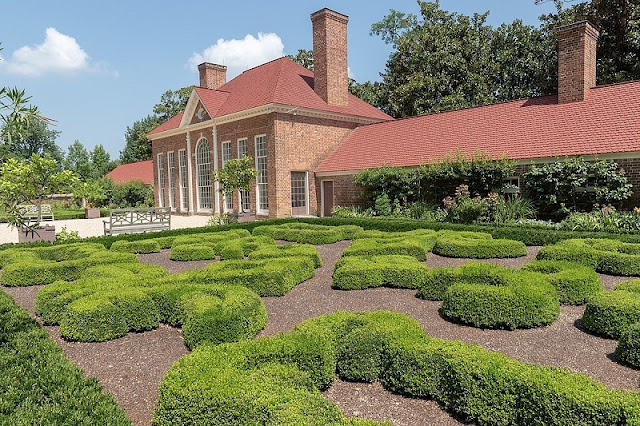
Mount Vernon's Greenhouse

The possibility of growing tender plants in greenhouses & providing exotic plants heat & sunlight during colder winter months had fascinated early Americans at least since the 1st half of the 18C in colonial British America. But the price of glass in colonial & early America remained high until nearly the middle of the 19C, making greenhouses available only to those with extra disposable income. Other terms used for these structures were stove house, conservatory, hothouse, pinery, & orangery.

In his 2003 book on The Green Spring Plantation, W. Kent Brinkley, Williamsburg based Landscape Architect & Historian gives us an overview of greenhouses in the 17C & 18C. "Structures erected to protect tender plants were more commonly called greenhouses in the 17C & 18C, although greenhouse & orangery were terms that were often used interchangeably. 

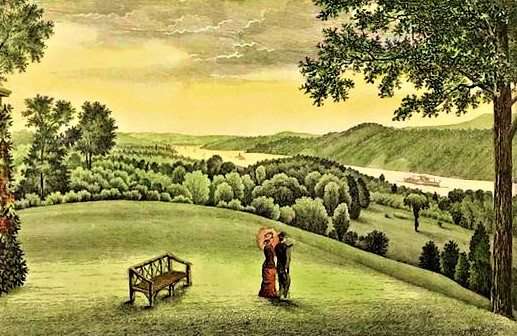
Another View of Mt Vernon

Reportedly. the concept of a greenhouse dates back to ancient Egypt, where they were said to grow grapes year-round as early as 4,000 B.C.  By 300 B.C. glasshouses were thought to be heated by manure pits.  Greenhouses, or earthen "sun pits," may have been invented by Romans or adopted from one of the many conquered countries of Rome. Glass was invented in Ancient Egypt around 3500 B.C. Production of larger, more clear or "aqua" glass panes as windows for churches were more prevalent around the late 7C CE. with Christian Anglo-Saxons.

A medical advisor to Roman Emperor Tiberius (Tiberius was the Emperor who ascended the throne after Augustus) told him that it was necessary for his health, to eat one cucumber (or perhaps a rather tasteless melon) a day. Roman scientists & engineers began brainstorming about how to grow plants year round. By 92 B.C. in Italy, Sergius Orata invented a heating system, with heat passing through flues in the floor.  At the time, the specularium, was glazed with mica.

Two agricultural writers, Lucius Junius Moderatus Columella (4CE-70CE) & Gaius Plinius Secundus (Pliny the Elder) (24CE-79CE) who lived during the reign of Tiberius (42 BCE-37 CE), both wrote about the 1st specularia or Roman Greenhouses. In the 1st century CE, these two Roman agricultural writers referred to protogreenhouses (specularia) constructed for the Emperor Tiberius (42 BCE–37 CE), presumably adjacent to his palace, the Villa Jovis on the Isle of Capri.

Pliny wrote (Book 19, 23: 64) that the specularia consisted of beds mounted on wheels which they moved out into the sun and then on wintry days withdrew under the cover of frames glazed with transparent stone (lapis specularis or mica). Apparently the specularia were built to provide, in Pliny’s words, a melon or cucumber for which the Emperor Tiberius had a remarkable partiality; in fact there was never a day on which he was not supplied with it. The Romans came up with the novel plan of growing the plants in wheelbarrows which they took outside during daylight hours and brought in at night. Unfortunately, sometimes this was not sufficient heat, and the plants died. So the intrepid gardeners began using 2 different materials to cover the plants. One was oiled cloth, known as specularia, and the other was thin transparent sheets of the rock, selenite. Eventually, they made their lives easier and built cucumber houses using specularia or selenite as a roof.

By 380, Italians were using hot water filled trenches to grow roses indoors. In the 1600s Europeans were using southern facing glass, stoves & manure to grow winter crops of citrus fruits. The growing sheds were called orangeries & later were heated with carts filled with burning coal.

In Korea, one of the earliest records of the Annals of the Joseon Dynasty in 1438 confirms growing mandarin trees in a Korean greenhouse during the winter and installing a heating system. The Koreans built structures to grow plants that they heated using a concept called ondol. This was a method of under-floor heating, and they grew mandarin oranges together with other plants in their greenhouses. This practice developed from 1438 to 1450 & was described in detail by European explorers.  

In the 13C, greenhouses were built in Italy to house the exotic plants that explorers brought back from the tropics. They were originally called giardini botanici (botanical gardens). The concept of greenhouses also appeared in the Netherlands & then England in the 17C, along with the plants.

One of the earliest greenhouses was built in Holland, by French botanist Jules Charles de Lecluse (1526-1609) in 1599 for the cultivation of tropical & medicinal plants. Charles L'Ecluse was botanist, also known as Carolus Clusius, aided the science of botany by cultivating exotic & fungal plants, including the potato (1588). L'Ecluse also wrote extensively on the subject of botany. He was appointed director of the emperor's garden in Vienna, Austria, from 1573-87 & in 1593 was made professor of botany at Leyden in the Netherlands. L'Ecluse 1st studied law in Belgium, then medicine in Germany; he received a medical degree in 1555. 

Originally built on the estates of the rich, greenhouses spread across Europe to the universities with the growth of the science of botany. The British sometimes called their greenhouses conservatories, since they conserved the plants. The French often called their 1st greenhouses orangeries, since they were used to protect precious orange trees from freezing. As pineapples became popular, pineries, or pineapple pits, were built. In Baltimore, a pinery was alternately called a stove house. In British colonial America, the mention of an early Boston greenhouse calls it a hothouse. The more generic terms “greenhouse” and “conservatory” came into general use as time passed, as did a few more  specific names referring to contents, such as “pinery, peachery, grapery & vinery.”

Experimentation with the design of greenhouses continued during the 17C in Europe, as technology produced better glass & as construction techniques improved. The greenhouse at the Palace of Versailles was an example of their size and elaborateness; The greenhouse at the Palace of Versailles was an example of their size & elaborateness; it was more than 500 feet (150 m) long, 42 feet (13 m) wide, and 45 feet (14 m) high.

Brinkley writes "As pineapples became popular, pineries, or pineapple pits, were built.al favor in England by the 1640s, when Charles l's consort, Queen Henrietta Maria, had a large greenhouse built for her at her estate at Wimbledon. At the height of their popularity in the 17C & early 18C, 169 different species of oranges were commonly grown in Europe & England, a fact that attests to the valuable & popular resources that fruit & citrus trees had become by that time. Yet, only the wealthiest families with the best foreign trade connections could afford to buy, keep, & maintain them properly."

"The oldest surviving royal English greenhouse is located at Hampton Court Palace, built by Sir Christopher Wren for William & Mary shortly after 1688. It was used to cultivate & maintain orange trees, myrtles, & oleander during the winter months, which then graced the intersections of paths in the garden during the summer.  In the warmer months, when plants were placed out in the garden, greenhouses often functioned as places for family relaxation & for entertaining guests. Queen Anne of England used her greenhouse at Kensington Palace as a summer supper house."

"Building a greenhouse during this period took a considerable amount of wealth, construction skill, & horticultural knowledge. The expense of handmade glass in the 17C somewhat limited its use in greenhouses until the price dropped by the mid-18C. By the 1730s, glass panes were being fixed into wooden sashes with wood beading or putty. The high cost of any glass used during this period largely dictated whether a gentleman could afford to build a greenhouse of any size in his gardens."

"Written sources during the late 17C& early 18C that recommended...that such structures be built no larger than 10 feet deep by 40 feet across to enable sunlight to fully penetrate to the rear north wall, & that the best greenhouses had other buildings, a dry hill, or a stand of tall trees placed to the north side of the structure. Doors should be wide enough to admit the passage of orange trees in tubs & the windows should be wide & high, extending from the floor nearly to the ceiling to admit sufficient light into the structure."

"Once greenhouses were built, the services of skilled, professionally trained gardeners were necessary to ensure success in raising & keeping exotic plants & citrus trees." This added to the expense.

Evidence suggests that gender roles in British Colonial America seemed fairly specific where the landscape was concerned...Usually married "women were...in charge of supervising the kitchen garden & the operation of greenhouse activities on their plantations, leaving to their husbands the direction of the design & more practical management of the pleasure gardens, orchards, & agricultural/farming activities." 

"Greenhouses came to be popularly regarded as status symbols in 18C English society, in part, not only because of the cost to build such structures & maintain them, but also because its physical presence in the landscape pointed out that the owner had the ability to manage the somewhat arcane art of regulating heat & light to preserve tender plants there. By inference, such a skill bespoke of one's ability to also control nature" & the people in the world around him.

"The cultivation of citrus trees, a difficult proposition under any conditions, & long associated with kings, nobles, & other influential men, became the quintessential symbol of prestige, leadership ability, & power among the elites of that day. Thus, possessing this capability on one's plantation also metaphorically demonstrated ones ability to lead & govern others. The presence of even a small greenhouse on one's plantation became a graphic symbol of horticultural power in the landscape that enabled politically powerful men to display their mastery over nature & to serve as a tangible marker of where the center of power resided." 

As British America was being colonized in the 17C, English garden writers were focusing on greenhouses which needed glass to allow the sun to reach the growing plants. Glass was becoming more affordable & glass no longer needed to be hand-blown. In England, in 1664, diarist & gardener John Evelyn (1620-1706) advised, "Set your...Windows and Doors of the Green-houses and Conservatories open." And in his diary on 30 October 1683, he mentioned, "Greene houses for oranges and mirtles." 
Detail John Evelyn (1620-1706) by Hendrick van der Borcht, 1641.  Born in Surrey into a family that owned the monopoly on the manufacture of gunpowder in England, Evelyn was able to devote his life to intellectual pursuits. In addition to translating noted French gardening books, Evelyn was the author of Kalendarium Hortense. His Diary is full of references to gardens, & to his own famous garden at Sayes Court. In 1691, the London Gazette mentioned another "new Conservatory or Green-House" in a house-for-sale ad.

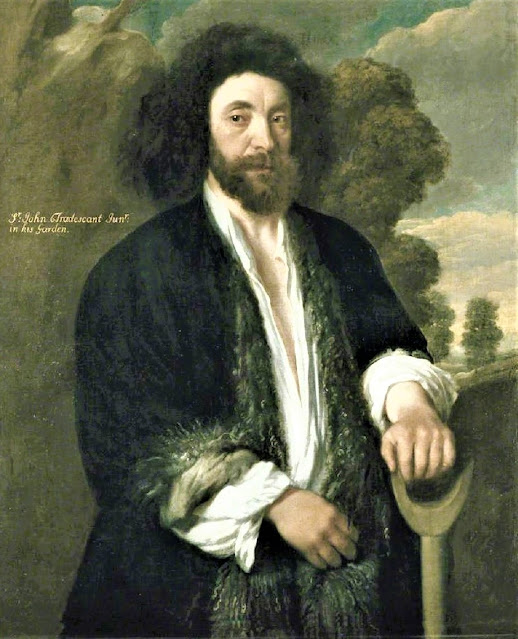
John Tradescant the Younger (1608-1662), son of John Tradescant the Elder, was a botanist & gardener. Like his father, who collected specimens and rarities on his many trips abroad, he undertook collecting expeditions to Virginia between 1628 and 1637.  Among the seeds he brought back, to introduce to English gardens were great American trees, including magnolias, bald cypress & tulip trees, plus garden plants such as phlox & asters. 

Brinkley writes, In 1656, John Tradescant the Younger documented a wide variety of tender exotic plants that were then being grown in greenhouses by plant collectors. The list in eluded oleander, bay trees, cypress, pomegranate, myrtle, hibiscus, passion flower, plumbago, canna lily, mimosas, geraniums, pelargonium, tender jasmines, solanum, asplenium, & daturas, in addition to the typically ubiquitous citrus trees. These plants would have been grown in decorative pots or wooden boxes, being placed out in the garden during the warm weather months.

In early 18C England, J. James' 1712 translation of Jean-Baptiste Alexandre Le Blond's (1679-1719) The Theory and Practice of Gardening; ; wherein is fully handled all that relates to fine gardening, commonly called pleasure gardens explained that,"Green-houses are large Piles of Building like Galleries...for preserving Orange-Trees, and other Plants...during the Winter." 
Le Blond was a French architect & garden designer who became the chief architect of Saint Petersburg in 1716, just 3 years before his death. He had derived his gardening expertise from André Le Nôtre (1613-1700), and he illustrated & helped write Dezallier d'Argenville's (1680-1765) seminal work on the principles of French formal garden design. 

In British America, colonials were reading English books on gardening, as they began to improve their estates. Richard Bradley FRS (1688-1732) was an English naturalist specializing in botanyFrom Britain, Richard  Bradley gave instructions for the greenhouse in his 1720 New Improvements of Planting and Gardening: “The Green-Houses, as they are commonly built, serve more for Ornament than Use; their Situation to receive the South Sun, is the only thing that seems to be regarded towards the Health of the Plants they are to shelter...with Flues under it, which convey the Heat from the Stoves...The Walls towards the North and the East must be of a good Thickness, but the Front towards the South should be all of Glass, excepting a low Wall about a Foot high from the Ground.”

In England, Phillip Miller had published a plan for a greenhouse in his 1754 Gardener's Dictionary, which was owned & read in the British American colonies. Miller was an English botanist & gardener of Scottish descent. Miller was chief gardener at the Chelsea Physic Garden for nearly 50 years from 1722, & wrote the highly popular The Gardeners Dictionary.

In his1764 edition, Miller wrote of the Green house or Conservatory. "As to the Length of these Houses, that must be proportion’d to the Number of Plants they are to contain, or the Fancy of the Owner; but their Depth should never be greater than their Height in the Clear; which in small or middling Houses may be 16 or 18 Feet; but for large ones, from 20 to 24 Feet...“The Windows in Front should extend from about one Foot and an half above the Pavement, to within the same Distance of the Cieling... The Piers between these Windows should be as narrow as possible to support the Building...of Stone, or of hard well-burnt Bricks... rais’d two Feet above the Surface of the Ground...Under the Floor, about two Feet from the Front, I would advise a Flue of about one Foot in Width, and two Feet deep, to be carried the whole Length of the House ... it will be very proper to have two Wings added to the main Greenhouse: which...will greatly add to the Beauty of the Building, and also collect a greater Share of Heat."

Much like today, the 18C colonial greenhouse was a glass-windowed structure of wood or brick or stone in which tender plants were reared & preserved. Revolutionary iron & glass greenhouses would appear in the first half of the 19C allowing more light into the structures.

Samuel Adams Drake (1833-1905) reported in his 1872 book Old Landmarks and Historic Personages of Boston that before 1737, merchant "Andrew Faneuil erected on this estate the first 'hothouse' in New England. The deed to him describes the mansion as 'a stone house." Others claim that he built the 1st greenhouse in the British American colonies. Faneuil was prominent in the Triangle Trade, a shipping route where merchants shipped fish & lumber from New England to Africa & then shipped slaves from Africa to the West Indies. After selling the slaves in the West Indies, merchants would then purchase molasses, sugar cane & rum from the local sugar plantations to bring back to the American colonies. Faneuil also owned a warehouse on Boston’s Merchant Row where he sold slaves. 

In an article published in the Florists' Exchange in 1895, by L. H. Bailey, are found some notes regarding the early history of greenhouses in this country. According to this authority, it is probable that the first glass house erected in this country was built in Boston by Andrew Faneuil, who died in 1737. Following his father’s death in 1719, Peter Faneuil & his younger brother Benjamin moved to Boston to apprentice with their uncle, Andrew Faneuil. By the time of their arrival, Andrew Faneuil had established himself as a successful merchant, amassing his fortune through a vast network of trade. Through his uncle, Peter Faneuil learned to navigate this commercial enterprise, eventually managing the operation, when Andrew became ill. In 1738, Andrew Faneuil died & left his entire fortune to Peter. This gentleman was an uncle of Peter Faneuil, who built Boston'd famous Faneuil Hall. 
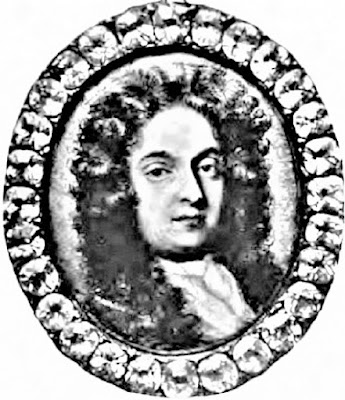
Virginian William Byrd II (1674-1768) painted by Hans Hysing 1724

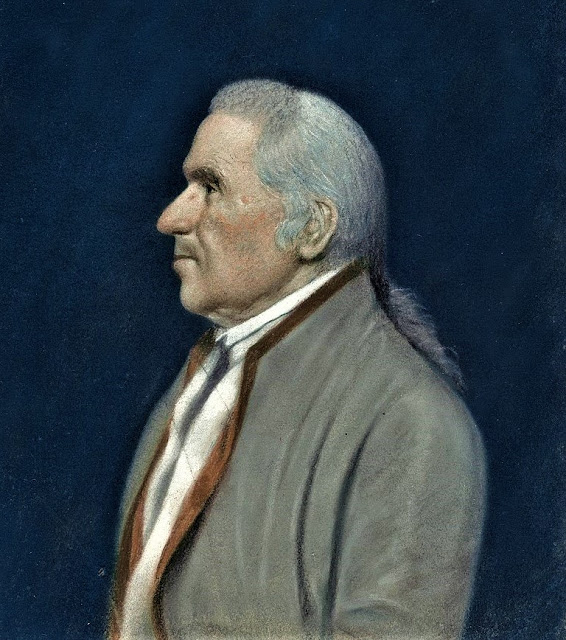
John Bartram (1699-1777) & his son William Bartram (1739-1823) 

Early in 18C Pennsylvania, botanist John Bartram (1699-1777) wrote to English botanist Peter Collinson (1674-1768), on July 18, 1740, about Colonel William Byrd's (1674-1744) grounds at Westover in Virginia. "Colonel Byrd is very prodigalle...new Gates, gravel Walks, hedges, and seddars cedars finely twined and a little green house with two or three orange trees...he hath the finest seat in Virginia."

Twenty years later, John Bartram wrote to Peter Collinson in 1760, “Dear friend, I am going to build a greenhouse. Stone is got; & hope as soon as harvest is over to begin to build it, to put some pretty flowering winter shrubs, & plants for winter’s diversion; not to be crowded with orange trees, or those natural to the Torrid Zone, but such as will do, being protected from frost.”
Peter Collinson 1694-1768

John Bartram was much more than just a commentator on the homes of colonial gentry, but he certainly would have been intrigued by the possibilities of Byrd's early greenhouse. Born in Darby, Pensylvania, son a Quaker farmer, Bartram became the most important botanist in the colonies. His son William Bartram (1739-1823) helped him collect, replant, & ship his specimens. In 1728, John Bartram established a botanic garden at Kingsessing on the west bank of the Schuylkill, near Philadelphia, where he collected & grew native plants. His correspondence with Peter Collinson, led to the introduction of many American trees & plants into Europe.
Charles Willson Peale's 1808 depiction of Botanist William Bartram (1739-1823) son of John Bartram (1699-1777) 

Greenhouses in Europe filled with Bartram's Boxes of American plants. His plant specimens & seeds traveled across the Atlantic to the gardens & greenhouses of Philip Miller, Linnaeus, German botanist Dillenius (1687-1747), & Dutch botanist Gronovius (1686-1762); and he assisted Linnaeus' student Swedish Pehr Kalm (1716-1779) during his collecting trip to North America in 1748-1750. Although Bartram never visited Britain, in 1765, he was appointed Botanist to King George III. Linnaeus called him "the worlds greatest botanist." Bartram traveled from Lake Ontario in the north, to Florida in the south and the Ohio River in the west. His Diary of a Journey through the Carolinas, Georgia and Florida, a trip taken from July 1, 1765, to April 10, 1766, was published. 

His son William accompanied his father documenting plants, animals, birds, & native peoples of North & South Carolina, Georgia & Florida. William published Travels, writings with his own illustrations in 1791, which impacted the 19C romantic movement as well as natural history.

William Penn's (1644-1718) Greenhouse at Springettesbury Manor 

Not far from Bartram's nursery just outside of Philadelphia, John Smith described the plantation owned by the family of William Penn (1644-1718)  at Springettesbury Manor in 1745,  “In the afternoon, the weather being so agreeable, John Armitt & I rode to Charles Jenki’s ferry on Schuykill. We ran & walked a mile or two on the ice. On our way thither we stopped to view the proprietor’s green-house, which at this season is an agreeable sight; the oranges, lemons & citrons were, some green, some ripe, some in blossom.” Springettesbury Manor had been named in honor of William Penn's first wife Gulielma Maria Springett (1644–1694).

Ten years later, Daniel Fisher also described the Pennsylvania Proprietor's greenhouse, "What to me surpassed every thing of the kind I had seen in America was a pretty bricked Green House, out of which was disposed very properly in the Pleasure Garden, a good many Orange, Lemon, and Citrous Trees, in great profusion loaded with abundance of Fruit and some of each sort seemingly ripe then." Bartram traveled South in the colonies through Charleston several times, where greenhouses were used to entice real estate buyers.

In the South Carolina Gazette, November 14, 1748, a house-for-sale advertisement noted, "TO BE SOLD...Dwelling-house...also a large Garden, with two neat Green Houses for sheltering exotic Fruit Trees, and Grape-Vines."

Exotic plants captured the fancy of colonials early in the century; and by the end of the 18th-century, formal botanical gardens dotted the Atlantic coast. These were both outdoor and indoor, public and private garden areas, where proud collectors displayed a variety of curious plants for purposes of science, education, status, and art.

Abraham Redwood Jr. (1709-1788) Rhode Island Hothouse & Greenhouse

Abraham Redwood Jr. (1709-1788), c. 1760, in a letter speaking of both his hothouse & his greenhouse wrote to his to his plantation manager, describing Redwood Farm, his seat in Portsmouth, RI “ I desire that you speak to your overseer to put up in Durt one dozen of Small orange Trees that has bore one or two years with the young fruit upon them, if to be had that has bore two or three years of Saffadella trees, four young figg trees & some Guavas roots, to put in my greenhouse, for I have made a garden of 1 1/2 acres of land & I have built a green house twenty-two feet long, Twelve feet wide & Twelve feet high, & a hotte house Sixteen feet long Twelve feet wide & Twelve feet high, & I have growing in my greenhouse Fifty young fruit trees from six inches to four feet high, & my Gardner says ye largest will not bear fruit these two years, & I have hotte house Strawberries, Bush beans & Crownations in Blossom.”

Abraham Redwood Jr. (1709-1788) by John Mason Furness (1763-1809) or by Sam King l,(1749-1819)

Abraham, Redwood's father (born in Bristol, England, in 1665) came into possession (by marriage) of a large sugar-plantation in Antigua, known as Cassada Garden, where he resided until 1712, when he removed to the British American colonies. After spending a few years in Salem, Massachusetts, he settled permanently in Newport, Rhode Island. His son was educated at Philadelphia, where he remained until he was 18. He returned soon afterward to Newport, married, & divided his time between his town & country residence. The latter was an estate of 145 acres at Portsmouth, Rhode Island, which is still known as "Redwood Farm," & remained in the family until 1882. Here Redwood bestowed much care on the cultivation of a botanical garden of rare foreign & indigenous plants, said to be the only one of its kind in the New England colonies. In 1743, Abraham Redwood had purchased the145 acres of farmland, where he built his country estate that was considered one of the most beautiful botanical gardens in North America, which growing plants & trees imported from all over the world.

Samuel Drowne noted on June 24, 1767, describing Redwood Farm, seat of Abraham Redwood Jr., Portsmouth, RI (Rhode Island Landscape Survey) “Mr. Redwood’s garden. . . is one of the finest gardens I ever saw in my life. In it grows all sorts of West Indian fruits, viz: Oranges, Lemons, Limes, Pineapples, and Tamarinds and other sorts. It has also West Indian flowers—very pretty ones—and a fine summer house. It was told my father that the man that took care of the garden had above 100 dollars per annum. It had Hot Houses where things that are tender are put for the winter, and hot beds for the West India Fruit. I saw one or two of these gardens in coming from the beach.”

John Dickinson (1732-1808) in Pennsylvania

Josiah Quincy (1744-1775), who kept a journal as he traveled South from Boston for his health in 1773, was also impressed with a greenhouse, when he visited Philadelphia on May 3, 1773, and noted, "Dined with the celebrated Pennsylvania Farmer, John Dickenson Esqr, at his country seat about two and one-half miles from town...his gardens, green-house, bathing-house, grotto, study, fish pond...vista, through which is distant prospect of Delaware River."  John Dickinson (1732-1808), who was actually an attorney trained at Middle Temple, had married Mary Norris, daughter of Isaac Norris, Speaker of the Pennsylvania Assembly, and moved to the Norris estate of Fairhill, near Germantown. There he wrote, under the pseudonym "A Farmer,"12 essays against the Stamp Acts.
1773 Charles Willson Peale (1741-1827). Mary Norris (Mrs. John Dickinson) daughter Sally.

In 1787, clergyman, merchant, & lawyer Manasseh Cutler (1742-1823), wrote of the greenhouse at Gray's Tavern, in Philadelphia. "(The Greenhouse) is a very large stone bulding, three stories in the front and two in the rear. The one-half of the house is divided lengthwise, and the front part is appropriated to a green-house, and has no chamber floors. It is finished in the completest manner for the purpose of arranging trees and plants in the most beautiful order. The windows are enormous. I believe some of them to be twenty feet in length, and proportionably wide...We then took a view of the contents of the green-house, beautifully arranged in the open air on the south of the garden. Here were most of the trees and fruits that grow in the hottest climates. Oranges, lemons, etc., in every stage from blossoms to ripe fruit; pine-apples in bloom, and those were fully ripe."

Visiting English agricultural writer Richard Parkinson (1748-1815) stopped at John O'Donnell's (1743-1805) estate named Canton near Baltimore, in 1798. Irishman John O'Donnell had grown wealthy by sending the first ship into China in 1785, for trade goods to sell in America. Parkinson wrote that O'Donnell had, "a very handsome garden in great order, a most beautiful greenhouse and hot house...a very magnificent place for that country."
1787 Charles Willson Peale (1741-1827). Sarah Chew Elliott (Mrs. John O'Donnell) in her garden in front of a curving wall with urns used as finials.

In 1793 Massachusetts, Boston merchant Joseph Barrell (1739-1804) was ordering plants & a gardener from Britain for his new Pleasant Hill greenhouse, "I want a person that understands green house plants...you will send the trees by the same opportunity the gardener comes that he may attend them on the passage." Wishing for more land outside of Boston to try new gardening styles & modern farming techniques, Barrell purchased 211 acres of land across the Charles River in Charlestown, where he created a ferme ornée. Charles Bulfinch designed the house & grounds, one of his 1st commissions.
John Singleton Copley (1738–1815) Joseph Barrell c 1767

Robert Morris, Jr. (1734-1806) 

In 1797, Médéric Louis Élie Moreau de St.-Méry recorded “I went......to visit Robert Morris’s greenhouse [serre chaud] near Philadelphia. It had very beautiful specimens of orange trees, lemon trees, & pineapples.”  Robert Morris, Jr. (1734-1806) was an English-born merchant & a Founding Father of the United States. He served as a member of the Pennsylvania legislature, the Second Continental Congress, & the United States Senate, and he was a signer of the Declaration of Independence, the Articles of Confederation, & the United States Constitution. From 1781 to 1784, he served as the Superintendent of Finance of the United States, becoming known as the "Financier of the Revolution." Along with Alexander Hamilton & Albert Gallatin, he is widely regarded as one of the founders of the financial system of the United States.
Robert Morris, Jr. (1734-1806) 

“A Schedule of Property within the State of Pennsylvania Conveyed by Robert Morris, to the Hon. James Biddle, Esq. And Mr. William Bell, in Trust for the use & account of the Pennsylvania Property Company,” September 6, 1797 “An Estate called the Hills Situate in the Northern Liberties, near the City of Philadelphia, containing Three hundred acres of land highly improved, & on which are erected a large & elegant greenhouse, with a hot house of fifty feet on each side; on the back front a House for a gardener, with one large & five small rooms, also two large rooms on the back or north front of the hot house, with an excellent vault under the green houses, & a covered room for preserving roots & c in winter; the whole being a strong stone building, with the necessary glasses, casements, fruit trees, plants shrubs & c in good order; a well of excellent water, with a pump close to the north front the whole enclosed within a large Garden stocked with fruit trees of the best kind &c. & c.”

John Singleton Copley (1738–1815) Hannah Fitch (Mrs Joseph Barrell) c 1771

In Deborah Logan's journal, she mentioned that in 1799 Philadelphia, William Logan had a "Green house in town, as well as a good one (at Stenton). He had many rare and beautiful plants: indeed the large and fine orange and lemon trees which now ornament Pratt's greenhouses at Lemon Hill were originally of his raising." William Logan (1717–1776) was the son of William Penn's secretary James Logan who became a Philadelphia Mayor & Supreme Court Justice. William inherited Stenton in 1751, and he used it as his country seat, while living in Philadelphia.

In the same year, English born seedsman and nursery owner William Booth of Baltimore advertised in the Federal Gazette and Baltimore Advertiser:To Botanists, Gardeners and Florists, and to all other gentlemen, curious in ornamental, rare exotic or foreign plants and flowers, cultivated in the greenhouse, hot-house, or stove, and in the open ground. A large and numerous variety of such rarities is now offered for sale...After reserving a general and suitable stock, he had to spare a well assorted and great variety of those things comprising a beautiful collection, sufficient to decorate, furnish, and ornament a spacious or handsome greenhouse at once...please apply to John Cummings, at the alms-house, Messrs. David and Cuthbert Landreth, gardeners and nursery-men... Now is as good time and proper season to build a green-house, and to remove plants."

Many of Booth's clients and contemporaries in the Chesapeake were becoming excited about collecting and displaying non-native varieties of plants. In his diary, silversmith, clockmaker, & gardener William Faris (1728-1804) noted in Annapolis that his neighbor Dr. Upton Scott (1722-1814) was, "fond of botany and has a number of rare plants and shrubs in his greenhouse and garden." The practical Faris used his cellar as his greenhouse.

 John Codman (1755-1803) of Lincoln, MA

John Codman described The Grange on August 24, 1800, “...behind which are stables (and) servants houses of various kinds, & in particular the gardens & greenhouses all of which are thus covered from sight...retirement is the object in this country. To be alone in the world as Adam & Eve were seems to be the taste, & the calm soft sweet scenes to be desirable.”

From March 1797 to August 1798, John Codman (1755-1803) invested more than $15,000 to update his mansion house, alterations attributed to Charles Bulfinch, in an attempt to imitate an English country estate. Codman altered the landscape to complement his mansion house by adding a large pleasure pond & planting long avenues of elms along the estate's driveway. John Codman was a charter member of the Massachusetts Society for Promoting Agriculture (1792). It was his service in the Massachusetts House of Representatives from 1796 to 1798 and in the Senate from 1800 to 1803 which earned him the title "the Honorable John Codman." He was building a house at the corner of Pearl & High streets in Boston in 1803 when, at the age of 48, he died in his house on Hanover Street & was later buried on the Boston Common.

Elias Hasket Derby (1739-1799) 

Eliza Southgate wrote of the Elias Hasket Derby Farm, Peabody, MA on , July 6, 1802 “We returned to the house, which was neat & handsome, & from thence visited the green house, where we saw oranges & lemons in perfection...every plant & shrub which was rare & beautiful was collected here.”  Elias Hasket Derby (1739-1799) was a Colonial American merchant and owner of a fleet of privateers. It took over 150 prizes during the American Revolution, and his large, swift Grand Turk was the first New England vessel to trade directly with China, making him not only one of the wealthiest & most celebrated traders of post-Revolutionary in Salem, Massachusetts.

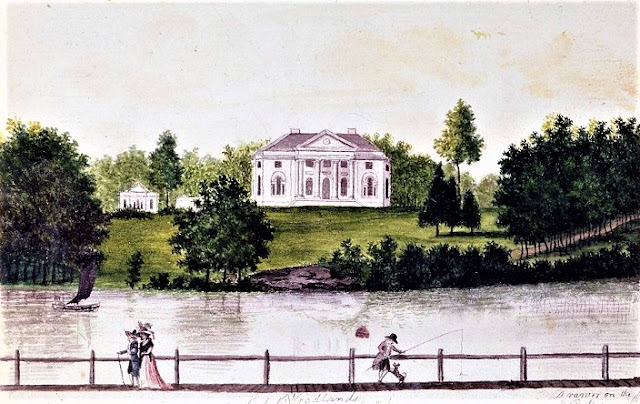
Philadelphian William Hamilton's (1745-1813) The Woodlands

Peller Malcolm, Woodlands, the Seat of W. Hamilton Esquire, from the Bridge at Gray's Ferry, Philadelphia, c. 1792–94. 

Some gardeners & plant collectors were obsessed with showing off their unusual plant collections to visitors. Philadelphian William Hamilton (1745-1813) constructed an enormous greenhouse flanked by 2 hothouses to cultivate his expanding collection of exotics at his Schuylkill River estate, The Woodlands. In 1767, 22-year-old William Hamilton moved from the family's large house at Bush Hill, in Philadelphia to this more remote site at a bend in the Schuylkill River. Here he would spend his life in the manner of an English country gentleman, cultivating his interests in architecture, landscape design, and botany. 

A young woman's 1788 letter describing the estate reported, “Mr. Hamilton was remarkably polite—he took us round his walks which are planted on each side with the most beautiful & curious flowers & shrubs they are in some parts enclosed with the Lombardy poplar except here & there openings are left to give you a view of some fine trees or beautiful prospect beyond & in others, shaded by arbours of the wild grape, or clumps of large trees under which are placed seats where you may rest yourself & enjoy the cool air—when you arrive at the bottom of the lawn along the borders of the river you find quite a natural walk which takes the form of the grounds entirely shaded with trees & the greatest profusion of grapes which perfumes the air in a most delightful manner, its fragrance resembles that of the Minionet...the walk terminates at the Green-house which is very large the front is ornamented with the greatest quantity of the most flourishing jesamine & honeysuckles in full bloom that I have ever seen—the plants are all removed to a place back of the Green house where they are ranged in the most beautiful order, they are so numerous that we had time to see only a very small part, every spring each plant is removed to a different spot."

The Woodlands also became one of the nation's most renowned botanical resources. At its height, Hamilton's impressive plant collection at The Woodlands contained approximately 10,000 species of native, foreign, and rare plants. Hamilton wrote on October 3, 1789, in a letter to his secretary, Benjamin Hays Smith, “Mr Child told me he would not fail to remind you of getting McIlvee out to mend the hot house. Unless this is done the West India plants cannot be safe. . . .I think it will be well enough for you to go to Bartrams & know from him what Hot House plants he intended for me and also his prices for each of the plants in ye enclosed list." 

One of Hamilton's neighbors Hipólito José da Costa Pereira Furtado de Mendonça, on February 24, 1799, wrote in his diary of The Woodlands, “Today I dined with Mr. Hamilton, who lives on the other side of the Schuylkill. He is a learned man very much taken with the subject of botany. In his hothouse he has many plants from China & Brazil, including 15 species of the sensitive plant & many other kinds of mimosa. He had one variety of sugar cane that comes from an island in the Pacific which is already being cultivated in the West Indies."  A month later, the visitor returned & once again wrote in his diary, “I went to Mr. Hamilton’s hothouse, where he awaited me with a catalogue of questions and then wrote down the answers as I gave them to him." 

David Hosack penned a letter on July 25, 1803, to Dr. Thomas Parke, regarding the greenhouses at the Elgin Botanic Garden and The Woodlands, “I duly received the plans of Mr. Hamiltons green & hot houses. My greenhouse [exclusive of the hothouses] is now finishing-it will not differ very individually from Mr. Hamiltons. It is 62 feet long 23 deep-and 20 high in the clear. I shall heat it by flues, they will run under the stays so they will not be seen-my walks will be spacious hot houses are for next summer’s operation. My collection of plants is yet small. I have written to my friends in Europe and in the East & West Indies for their plants. I will also collect the native productions of North & South America. What medical plants can Mr. Bartram supply-request him to send me a catalogue. I hope William Hamilton will have duplicates of rare and valuable plants. I will supply him anything I possess.”

On the return of Lewis and Clark, Thomas Jefferson asked Hamilton, an outstanding authority on plants and their cultivation, to germinate three lots of seeds that they had collected. About that time, Jefferson invited Hamilton to help design the gardens at Monticello.

In fact both Jefferson and Lewis corresponded with Hamilton. From St. Louis in March of 1804 Lewis sent Jefferson some cuttings from an Osage orange tree, asking him to forward part of them to Hamilton. Upon departing Fort Mandan in the spring of 1805 he sent a box containing 60 plant specimens to Jefferson, who sent them to the American Philosophical Society with a request to send them to Hamilton for planting. In early January of 1807 Jefferson wrote to the Philadelphia botanist and gardener Bernard McMahon that Lewis had returned to Washington City with "a considerable number of seeds," which the President recommended McMahon share equally with Hamilton. It seems likely that Lewis delivered them in person. We know of only 19 of the species that were represented in this later collection, including black, yellow, and red currant, "Ricara Currant," and a "large species of Tobacco." On 3 February 1808 Hamilton informed Jefferson that not all the seeds he received had germinated as yet, but he had succeeded in growing "the yellow wood, or Osage apple, seven or eight sorts of gooseberries currants & one of his kind of aricarara tobacco."

On July 25, 1803, David Hosack mentioned in a letter to Dr. Thomas Parke, Hamilton's greenhouse at The Woodlands, “I duly received the plans of Mr. Hamiltons green and hot houses. My greenhouse [exclusive of the hothouses] is now finishing - it will not differ very individually from Mr. Hamiltons...I hope William Hamilton will have duplicates of rare and valuable plants - I will supply him anything I possess.”
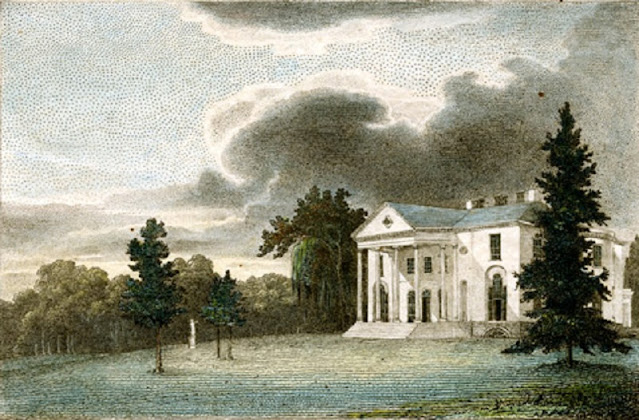
In November of 1803, Manasseh Cutler (1722-1823) wrote to Mrs. Torrey about his visit to Hamilton's Woodlands, Philadelphia, Pennsylvania, "We then took a turn to the garden and greenhouses...ornamented with almost all the flowers and vegtables the earth affords...The greenhouses which occupy a large space of ground, I cannot pretend to describe. Every part was crowded with trees and plants, from the hot climates, and such as I had never seen...He assured us, there was not a rare plant in Europe, Asia, Africa, from China and the islands in the South Sea, of which he had any account, which he had not procured...When we turned to rare and superb plants, one of the gardeners would be called, and sent with a lantern to the green house to fetch me a specimen to compare with it. This was done perhaps twenty times."   

William Russell Birch, “Woodlands the Seat of Mr Wm Hamilton Pennsylvania,” in The Country Seats of the United States of North America with some Scenes connected with them 1808. “This noble demesne has long been the pride of Pennsylvania. The beauties of nature & the rarities of art, not more than the hospitality of the owner, attract to it many visitors. It is charmingly situated on the winding Schuylkill & commands one of the most superb water scenes that can be imagined. The ground is laid out in good taste. There are a Hot house & green house containing a collection in the horticultural department, unequalled perhaps in the Unites States...”

Hamilton constructed his large greenhouse & 2 hothouses to cultivate his expanding collection of exotics. Charles Drayton, on November 2, 1806, described The Woodlands, “Dined at Mr. Hamilton’s, at his elegant seat about 3 miles from Philadelphia...“One is led into the garden from the portico, to the east or lefthand. or from the park, by a small gate contiguous to the house, traversing this walk, one sees many beauties of the landscape—also a fine statue, symbol of Winter, & age,—& a spacious Conservatory about 200 yards to the West of the Mansion.
“The Conservatory consists of a green house, & 2 hot houses—one being at each end of it. The green house may be about 50 feet long. The front only is glazed. Scaffolds are erected, one higher than another, on which the plants in pots or tubs are placed—so that it is representing the declivity of a mountain. At each end are step-ladders for the purpose of going on each stage to water the plants—& to a walk at the back-wall. On the floor a walk of 5 or 6 feet extends along the glazed wall & at each end a door opens into an Hot house—so that a long walk extends in one line along the stove walls of the houses & the glazed wall of the green house.
“The Hot houses, they may extend in front, I suppose, 40 feet each. They have a wall heated by flues—& 3 glazed walls & a glazed roof each. In the center, a frame of wood is raised about 2 1/2 feet high, & occupying the whole area except leaving a passage along by the walls. In the flue wall, or adjoining, is a cistern for tropic aquatic plants. Within the frame, is composed a hot bed; into which the pots & tubs with plants, are plunged. This Conservatory is said to be equal to any in Europe. It contains between 7 & 8000 plants. To this, the Professor of botany is permitted to resort, with his Pupils occasionally.
“As the position of many plants require external exposure in the Summer season that also is contrived with much ingenuity & beauty.
“There are 2 large oval grass plats in front of the Conservatory—& 2 behind. Holes are nicely made in these, to receive the pots & tubs with their plants, even to their rims. The tallest are placed in the centre, & decreasing to the verge. Thus they represent a miniature hill clothed with choice vegetation.”

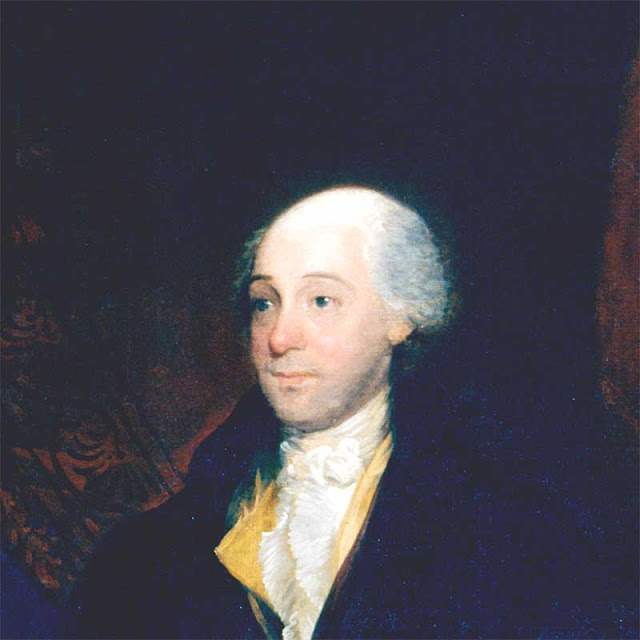
William Hamilton (1745-1813) of Woodlands Detail by Benjamin West (American, 1738–1820) 

Authors Joseph Dennie & John Elihu Hall reported on the greenhouse at the Woodlands in their 1809 Portfolio II, "The front, including the hot-house on each side, measures one hundred and forty feet, and it contains nearly ten thousand plants, out of which number may be reckoned between five and six thousand of different species, procured at much trouble and expense, from many remote parts of the globe, from South America, the Cape of Good Hope, the Brazils, Botany Bay, Japan, the East and West Indies, &c. &c. This collection, for the beauty and rich variety of its exotics, surpasses any thing of the kind on this continent; and, among many other rare productions to be seen, are the bread-fruit tree, cinnamon, allspice, pepper; mangoes, different sorts, sago, coffee from Bengal, Arabia, and the West-Indies, tea, green and bohea, mahogany, magnolias, Japan rose, rose apples, eherimolia, one of the most esteemed fruits of Mexico, bamboo, Indian god tree, iron tree of China, ginger, olea fragrans, and several varieties of the sugar cane, five species of which are from Otaheite. To this green-house, so richly stored, too much praise can hardly be given. The curious person views it with delight, and the naturalist quits it with regret."

Meanwhile, further South on November 25, 1805, the Norfolk Gazette & Publick Ledger described the Museum Naturae, Norfolk, VA “MUSEUM NATURÆ, of Norfolk & Portsmouth...“Botanical Garden, containing specimens of all the vegetable productions of this country, & furnished with green-houses, for all such exotick & rare plants, as may be procured from abroad.”

Thomas Jefferson wrote on March 1, 1808, in a letter to William Randolph, describing Monticello, plantation of Thomas Jefferson, Charlottesville, VA “...my green house is only a piazza adjoining my study, because I mean it for nothing more than some oranges, Mimosa Farnesiana & a very few things of that kind. I remember to have been much taken with a plant in your green house, extremely odoriferous, & not large.”

Rosalie Stier Calvert (1795-1821)

On Christmas day in 1803, in Prince George's County, Maryland, Rosalie Stier Calvert (1795-1821) wrote to her father who had returned to Europe, "I am also going to have a small greenhouse built where you planned it--at the wash-house. The cellar makes a very good orangerie." In another letter to her father in 3 years later, she mentioned that the cellar would no longer serve as the greenhouse, "We also have to build a small house, a smoke house, a sairy, and an orangerie."
Gilbert Stuart (Early Americn artist, 1755-1828). Rosalie Stier Calvert (1778 -1821) in 1804

In Maryland, Rosalie Calvert grew plants in pots that could be brought outside in warm weather or ornament the interior of Riversdale house in winter. In 1803, she wrote, “I have arranged all the orange trees and geraniums in pots along the north wall of the house, where they make a very pretty effect, and the geraniums, being shaded, bear many more blossoms and are growing well.”

By 1809, she had added several more types of potted plants, and wrote that they were “a marvelous source of entertainment for me—geraniums, heliotropes, jasmines, China rose bushes, etc. I don’t have any aloes or any of those other plants whose only recommendation is their rarity and which lack beauty.” Heliotropes, she wrote, would be transplanted “outdoors in the summertime with the geraniums, jasmine, rose bushes, etc.”  

Rosalie Calvert's orangerie never materialized. Instead, she used a central room of the house, her “grand salon,” with three large south-facing triple-hung windows, as her conservatory. She bragged to her father in 1813 about “my lemon trees. I have four superb specimens which in winter we place in the four corners of the salon, where they make a lovely effect. Last November one of them produced 87 large lemons.”

American diplomat David Bailie Warden visited Riversdale and described Rosalie's salon, "The hall is ornamented with lemon-trees, geraniums, polianthusses, heliptropes, and other plants, which in the summer evenings, invite the humming-birds to taste of their sweetness; and afterwards struggling to escape, they fly incessantly backwards and forwards near the ceiling, until from fatigue they perch on a stick or rod, when they are easily taken by the hand."

There are early references to orangeries  in England, where John Evelyn wrote in his diary on 4 July 1664, "The orangerie and aviarie handsome, and a very large plantation about it." Another reference appears in the 1705 London Gazette, "The Mansion-House, called Belsize, ...with...a fine Orangarie, is to Lett."

In America in 1790, Thomas Lee Shippen, describing Stratford Hall in Virginia, to his father reported, "It was with great difficulty that my Uncles, who accompanied me, could persuade me to leave the hall to look at the gardens, vineyards, orangeries and lawns which surround the house."

Kirk Boott wrote of his own home on April 15, 1806, in Boston, MA “...my Greenhouse has flourished beyond my expectation, & what pleases me much, I have found my skill equal to the care of it. Lettuces in abundance I have preserved, & have had fine Sallads thro’ the Winter.”

David Hosack wrote in, 1806, describing Elgin Botanic Garden, New York, NY “In the year 1801 I purchased, of the Corporation of the city of New-York, twenty acres of ground; the greater part of which is now in cultivation. Since that time, a Conservatory, for the more hardy green-house plants, has been built.”

In 1810, Joseph Newton, Arthur Smith, John E. West, & Timothy B. Crane described the Elgin Botanic Garden, New York, NY (quoted “Estimate of the Buildings at the Botanic Garden. “We, the subscribers, builders, & residents of the city of New-York, at the request of doctor David Hosack, have valued the improvements on his land, near the four mile stone, called the botanic garden, to wit: the hot bed frames, the conservatory or green house, & its appendages, the dwelling house, the hot houses & their back buildings, the lodges, the gates & the fences around the land, including the wells, at the sum of twenty-nine thousand three hundred dollars.”

Another nurseryman living in Philadelphia was also promoting plants and pleasure gardens. In 1806, Irish American horticulturalist, seedsman, & writer Bernard M'Mahon (1775-1816), whose book would be read by gardeners in America for the next 50 years, explained the difference between the greenhouse and a conservatory, "A Green house is a garden building fronted with glass, serving as a winter residence, for tender plants from the warmer parts of the world, which require no more artificial heat than what is barely sufficient to keep off the front...A greenhouse should generally stand in a pleasure ground and if possible, upon a somewhat elevated and dry spot fronting the south...the building ought to be of brick or stone, having the front almost wholly of glassowrk, ranging lengthwise east to west, and constructed upon an ornamental plan...

"The Greenhouse and Conservatory have been generally considered as synonimous; their essential difference is this: in the greenhouse, the trees and plants are either in tubs or pots, and are planted on stands or stages during the winter, till they are removed into some suitable situation abroad in summer.

"In the conservatory, the ground plan is laid out in beds and borders, made up of the best compositions of soils that can be procured, three or four inches deep. In these the trees or plants, taken out of their tubs or pots are regularly planted, in the same manner as the plants in the open air.

"This house is roofed, as well as fronted with glass-work, and instead of taking out the plants in summer, as in the Greenhouse, the whole of the glass roof is taken off, and the plants are exposed to open air."

M’Mahon also wrote that the difference between a greenhouse and hothouse was that a greenhouse had only enough artificial heat to “keep off frost and dispel damps,”[1] whereas the latter had an interior stove and was covered in more glass (view text) (see Conservatory, Greenhouse, and Orangery).

1799 Ann Ogle (Mrs. John Tayloe III) and daughters Rebecca and Henrietta.

The Minute Book of John Tayloe III (1770-1828) noted on August 2, 1812 at his country seat Mount Airy in Richmond County, Virginia, "Gardeners attending to the Greenhouse at Mt. Airy." Tayloe's city residence was Octogon House in Washington D. C.

Wye House (18C greenhouse with hot air duct system, still owned by descendants of Edward Lloyd) Copperville, Talbot County, Maryland. Photo by Janet Blyberg.

By the time Englishman John Claudius Loudon (1783-1843) wrote his 1822 Encyclopedia of Gardening, the orangery had fallen out of favor. He wrote, "The orangery is the green-house of the last century, the object of which was to preserve large plants of exotic evergreens during winter, such as the orange tribe, myrtles, sweet bays, pomegranates, and a few others. Geraniums, heaths, fuchsias, and other delicate plants requiring much light, were then unknown. The orangery was generally placed near to or adjoining the house, and its elevation corresponded in architectural design with that of the mansion. From this last circumstance has arisen a prejudice highly unfavorable to the culture of ornamental exotcis, namely, that every plant-habitation attached to a mansion should be an architectural object, and consist of windows between stone piers or columns, with a regular cornice and entablature. By this mode of design, these buildings are rendered so gloomy as never to present a vigorous vegetation, and vivid glowing colors within ; and as they are thus unfit for the purpose for which they are intended, it does not appear to us...that they can possibly be in good taste."

By the early 19C in the new republic, gentlemen were building greenhouses, conservatories, orangeries, hot houses, pineries, and stove houses to grow tender plants for their food value and to impress their neighbors. Some even had their portraits painted holding their favorite tender potted plants.
 1801 Rubens Peale with Geranium by Rembrant Peale (1778-1860) 

Monday, January 3, 2022

1764 Garden Design - A Son in Scotland Advises His Father in Hyde Park, NY on Pleasure Gardens

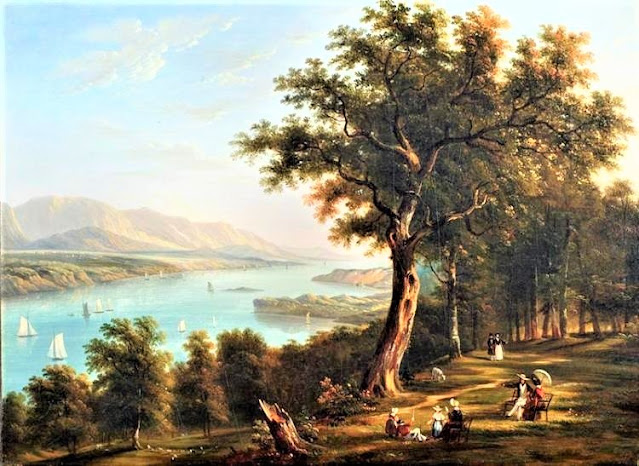
19C Hyde Park by Victor de Grailly (French artist, 1804-1889)

Along the east side of the Hudson River in Dutchess County, New York, Peter (Pierre) Fauconnier (1659–1746), received a 3,600-acre tract of property located on the banks of the river 75 miles north of New York City. He named it Hyde Park after the Governor of New York, Sir Edward Hyde, Lord Cornbury (1661–1723).  Peter came to America as the private secretary to Edward Hyde, the 3rd Earl of Clarendon whose cousin, Queen Anne, had appointed him Governor of New York & New Jersey. In 1705.

Governor of New York, Sir Edward Hyde, Lord Cornbury (1661–1723)

The undeveloped property descended through Fauconnier’s family until 1764. Peter Fauconnier owned Hyde Park from 1705–1746. His daughter Magdalene Fauconnier Valleau 1746–1764 inherited the land at her father's death. In 1764, the river-front land was inherited by his granddaughter, Suzanne Valleau (1720–1784), & her husband, the New York City surgeon Dr. John Bard (1715–1799). At Dr. Bard's death, the property passed on to the son who advised his father, Dr. Samuel Bard (1799–1821.) 

Peter (Pierre) Fauconnier (1659–1746) Private Secretary to Edward Hyde, the Earl of Clarendon 

Dr. John Bard (1715–1799) initially contemplated developing the land that he had inherited into a rural country seat & settling there after retiring from his medical practice in New York City. He received advice on “laying out your grounds” & “planning a pleasure ground” from his son, Samuel Bard (1742–1821), a medical student in Edinburgh who was well versed in contemporary landscape design in Britain & Scotland. 

New York surgeon Dr.  John Bard (1715–1799), the father in Hyde Park, NY 

Samuel Bard's, April 1, 1764, letter from Edinburgh to his father Dr. John Bard “I heartily wish I could be with you at laying out your grounds, as I imagine I could be of some assistance, although I may find it impossible to convey my notions upon that subject in writing. From what I have as yet seen, I find those the most beautiful where nature is suffered to be our guide. The principal things to be observed in planning a pleasure ground, seem to me, to be the situation of the ground, & the storms & winds the country is most liable to. By the first, I mean, to distribute my plants according to the soil they most delight in; to place such as flourish most in a warm exposure & dry soil, upon the sunny side of a hill; while such as delight in the shade &moist ground, should be placed in the vallies. By this single precaution, one of the greatest beauties of a garden is obtained, which consists in the health & vigour of the plants which compose it. By considering well the predominant winds & storms of the country, we are directed where to plant our large trees, so that they shall be at once an ornament, & afford a useful shelter to the smaller & more delicate plants. Next I think straight lines should be particularly avoided except where they serve to lead the eye to some distant & beautiful object—serpentine walks are much more agreeable. Another object deserving of attention seems to be, to place the most beautiful & striking objects, such as water, if possible, a handsome green-house, a grove of flowering shrubs, or a remarkably fine tree, in such situations, that from the house they may almost all be seen; but to a person walking, they should be artfully concealed until he suddenly, & unexpectedly, comes upon them; so that by the surprise, the pleasure may be increased: & if possible, I would contrive them so that they should contrast each other, which again greatly increases their beauty. The last thing I should mention, which, indeed, is not the least worthy of notice, is, to throw the flower garden, kitchen, & fruit garden, & if possible, the whole farm, into one, so that they may appear as links of the same chain, & may mutually contribute to the beauties of the whole. If you could send me an accurate plan of the situation of your ground, describing particularly the hollows, risings, & the opportunities you have of bringing water into it, the spot where you intend your house, & the situation of your orchard, I would consult some of my friends here about a proper plan, & I believe I know some who would assist us, & as I cannot obtain your gardener before November, if you sent the plan immediately, I shall be able to return it by him.” 

Financial worries led the NYC surgeon to try to sell the land. Only 4 years later, John Bard decided to offer his property for sale, May 12, 1768, New York advertisement offering sale of Hyde Park.  “To be sold by the subscriber, living in New-York, either all together, or in distinct farms, a tract of land in the county of Dutchess, & province of New-York, called Hyde Park, or Paulin’s Purchase... containing 3600 acres. The tract in general is filled with exceeding good timber...& abounds in rich swamps; great part of the upland exceeding good for grains or grass, & has on it some valuable improvements...A Large Well -Improved Farm, with a good house, a large new barn, a young orchard of between 500 or 600 apple trees, mostly grafted fruit, & in bearing order; between 30 & 50 acres of rich meadow ground, fit for the scythe; & about 150 acres of upland cleared & in tilling order. There is belonging to the said tract, 3 good-landing-places (particularly one on the above farm) where the largest Albany sloop can lay close to a large flat rock, which forms a natural wharf.” Eventually he decided not to sell the property.

 Dr. Samuel Bard (1742–1821) the son studying to become a physician abroad

The young son Samuel Bard had developed his interest in plants & botany some time before sailing across the Atlantic for his formal medical education. Several years before traveling to England, the New York surgeon's ailing 14-year-old son Samuel spent a summer at the farm of his father’s friend Cadwallader Colden (1688-1776) who was a physician, a botanist, a lieutenant governor & acting Governor for the Province of New YorkHere young teen Samuel Bard received instruction in botany from Colden & his daughter Jane (1724–1766), both of whom had mastered Carl Linnaeus’s system of plant classification while cataloging indigenous New York flora. Jane Colden was one of the the first female botanist working in America. An accomplished draftsman, the young Bard reportedly “repaid the lady for her instruction, by making figures & drawings of plants for her."

When young Samuel Bard landed in London in the spring of 1762, he began a course of medical instruction under the Quaker physician, philanthropist, & plant collector John Fothergill (1712–1780), & devoted his summers to botanical investigations in the countryside.

In 1764, after transferring to the University of Edinburgh, Bard received an award in botany from John Hope (1725–1786), Professor of Botany & Materia Medica & King’s Botanist, for producing “the best herbarium or collection of dried plants, growing spontaneously within ten miles of Edinburgh.” In addition to combing Scotland's countryside for plants, the student Bard toured local estates studying landscape & garden design. His father soon asked him to find a gardener there to help lay out the grounds of his father’s Hudson river estate, Hyde Park.

When Dr. John Bard's son Samuel returned to New York, the young man had spent 5 years in France, England, & Scotland, finally receiving his M.D. at the University of Edinburgh in May 1765. On his return to New York, he found his father in debt for his overseas education, which had cost more than 1000 pounds. New physician Samuel entered into partnership with his surgeon father, & for 3 years drew nothing beyond his expenses from the profits of the medical business, amounting to 1,500 a year.

On his Hyde Park property, in 1772, Dr. John Bard built a house along the east side of the Albany Post Road also known as the “Red House,” & a second residence across the road known as Bard Cottage. He also maintained a farm, mills, a store, & 3 boat landings along the Hudson, the southerly one known as Hyde Park Landing & the northerly called Bard’s Rock.

In 1784, after an innovative & esteemed medical career in New York City, Dr. John Bard sought the retiring, pastoral life often longed-for by those of his position & generation. Dr. John Bard had been raised in privileged circumstances, on a farm estate near Philadelphia. He was a close acquaintance of Benjamin Franklin (1706-1790) & enjoyed a well-earned professional reputation in medicine, but he felt it was time to retire.. 

While participating in the cultural activity of New York City, Dr. John Bard had a deep-rooted appreciation for plants & country life. As a medical practitioner, he had a direct involvement with medicinal botany & horticulture. But he longed for the bucolic charms of Hyde Park as an ideal situation, somewhat removed from the basic economic & functional pre-occupation of earlier Hudson River estate owners. In fact, he had on-going financial difficulties & his aspirations for Hyde Park were tempered by the reality of his financial situation. His ornamental landscape improvements were limited. 

In 1795, Dr John Bard, then being in his 80th year, gave an address before the state medical society calling attention to the presence of yellow fever in the city, meeting much opposition & some vehemently expressed disapproval, by so doing. Nevertheless, his advice as to treatment of this dread disease-sweating the patient-proved more successful than other methods. In 1798 he gave up his medical practice & retired to Hyde Park where he died, March 30, 1799, at the age of 83.

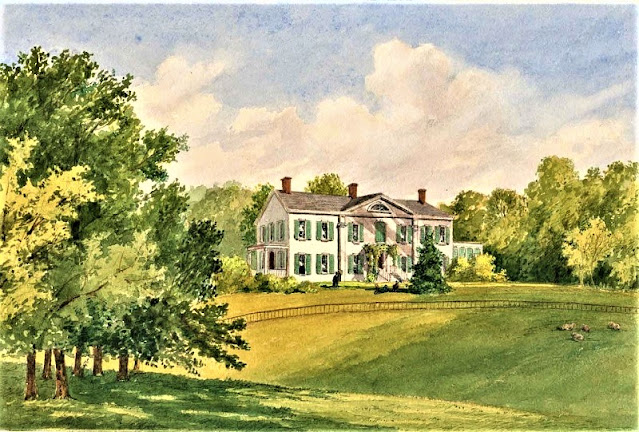
Dr. Samuel Bard’s Residence. Hyde Park, 1871, watercolor copy of a drawing of c. 1800–23

In 1799 New York surgeon Dr. John Bard left the 1,500-acre core of the estate to his son, Dr. Samuel Bard (1742–1821.) The younger Bard was responsible for establishing the formal residential grounds, known as the park, on the river side of the Post Road, leaving the land to the east including the “Red House” as the estate farm. He built a mansion on the terrace overlooking the Hudson Valley.
An English print of a seemingly exhausted Dr. Samuel Bard (1742-1821)

Dr. Samuel Bard developed his home at Hyde Park while in his mid-50's, when his taste was well established. The house, an elegant Federal style structure was intentionally planned to sit away from his father's farm complex & "Red House." The more formal new house was sited at the edge of the escarpment, at a point that protrudes, allowing a 180 degree prospect to the west. The selection of this location is indicative of a Federal period interest in dramatic houses & powerful sitings on the the hills above rivers. From this location, one could see look out to the boats & travelers passing by on the river & the bright white structure could also be seen by those passing by. This preference in siting houses was in fashion for at least a quarter century. Later a blatantly exposed mansion house would be considered ostentatious. 

Dr. Samuel Bard (1742-1821) is considered, along with his father Dr. John Bard & Dr. Benjamin Rush of Philadelphia, one of the leading physicians of the colonial & early federal periods. But Bard was also very interested in the study of botany.  While his father was more interested in the commercial potential of the family estate in Hyde Park, Samuel indulged his love of plants & botany there. Always looking for agricultural improvements, in 1806 he founded the Dutchess County Agriculture Society, serving as its president for many years & using his position to advocate for the use of clover as a crop & gypsum as a fertilizer. Samuel enjoyed landscaping the more formal grounds of his estate, & he set about planting exotic plants & trees. There is a large Ginko tree on the lawn, that he is said to have planted in 1799, which would make it one of the oldest in North America. The greenhouse he built in 1820 is said to have been the 1st in Dutchess County.

19C Engraving by artist E. White of the Hudson River as seen from Hyde Park 

After positioning his house, Dr. Samuel Bard laid out the kitchen gardens, & later the greenhouse about 1,000 feet south of the house on a sheltered south facing slope. In selecting this location, Samuel Bard was following his own, early advice to his father, expressed in a 1764 letter, to consider the best advantage of the natural site in placing the various site components: "The principal thing to be observed in planning a pleasure ground, seems to me to be the situation of the ground, & the storms & winds, the country is most liable to." 

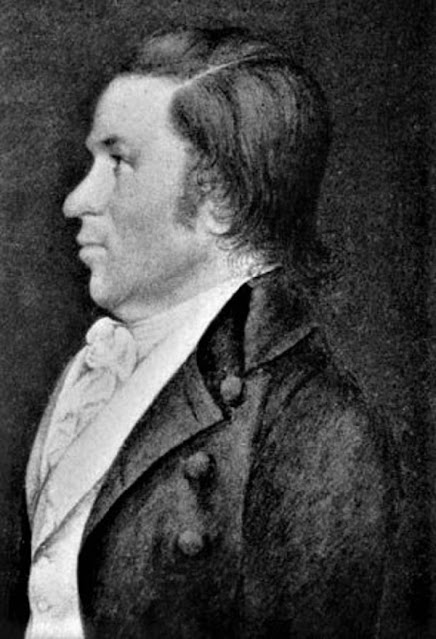
Said to be Dr Samuel Bard (1742-1821) Actually looks like a young depiction of his father.

During the early years of his return to New York, he established a medical school at King’s College. now Columbia University. In 1769 he began lobbying for the city’s 1st public hospital. In Britain, Bard’s friend & mentor, John Fothergill, spearheaded fundraising for the hospital there, & King George III granted it a charter in 1771; but the Revolutionary War intervened. When the hospital was finally completed in 1791, Bard reportedly laid out a botanic garden at the hospital occupying 2 city blocks, in which he cultivated medicinal herbs. Bard also served as one of George Washington's private physicians, saving his life in 1789 by removing a malignancy from his leg. In 1811, College of Physicians & Surgeons was founded in New York, Bard was appointed its president, serving in that capacity until his death in 1821.

Friday, December 31, 2021

Labor - South Carolina Garden Contractors

Charles Fraser (1782- 1860). Mr. Gabriel Manigault's Seat at Goose Creek, 1802. The Carolina Art Association Gibbes Museum of Art, Charleston, South Carolina. The estate was called Steepbrook.

Independent Gardeners Working in South Carolina

Gardeners appear in South Carolina records in a variety of ways--deeds, estates, administration records, and newspapers. Often, the identification "gardener" is all that is available about these men. They don't place ads seeking work or advertising plants, but they should not be ignored.
1796. Charles Fraser (1782-1860). The Seat of Joseph Winthrop, Esq. on Goose Creek, South Carolina. The Carolina Art Association Gibbes Museum of Art, Charleston, South Carolina. Joseph Winthrop was married to Charles Fraser's older sister.  Thanks to South Carolina native Charles Fraser (1782 - 1860 ) we have a chance to see, through his eyes, the homes & gardens there as he was growing up. These were some of the gardens & grounds, that the independent gardeners listed here helped plant & tend. Although Fraser was primarily known for his miniature portraits, he created watercolors of historical sites, homes, & landscapes, while also working as a lawyer, historian, writer, & politician. Today, many of Fraser's works are housed & displayed in Charleston's Carolina Art Association Gibbes Museum of Art.

The first professional gardener on record in South Carolina was a Frenchman. Mathurin Guerin was a French Huguenot who took refuge in the province and requested to be naturalized as an English citizen under the act passed on March 10, 1697, designed to grant to all aliens that were inhabitants of the Province of South Carolina the same privileges as those persons born of English parents. Mathurin Guerin was a native of St. Nazaire, son of Pierre Guerin, and of Jeanne Bilbau. His wife was Marie Nicholas, daughter of Audre Nicholas and Francoise Dunot.

While Guerin may have been the first French Huguenot gardener in South Carolina, he certainly was not the last. French gardeners and seedsmen arrived in the Mid-Atlantic and upper south after the Revolutionary War. But in South Carolina, French gardeners influenced the gardening from the beginning of the 18th century. South Carolina saw a large influx of French Huguenots – individuals who were probably familiar with the garden designs of Le Nôtre. Garden designs in South Carolina continued to have a formal aspect well into the 19th century.
1803. Charles Fraser (1782-1860). Ashley Hall near Charleston, South Carolina.The Carolina Art Association Gibbes Museum of Art, Charleston, South Carolina. Fraser wrote in his Reminiscences that the oak trees were planted by a "visitor," Mark Catesby, who came to Carolina in 1722, and whose Natural History of Carolina, Florida, and the Bahama Islands was published in England a decade later.

More independent white gardeners appear in South Carolina records earlier than in the northern colonies. While most independent gardeners in the Mid-Atlantic and upper south worked in public gardens, fewer independent gardeners appear in the records at private properties in early Pennsylvania, Maryland, and Virginia during the first half of the 18th century.
Charles Fraser (1782-1860). A Seat on the Ashely River, April, 1802. Carolina Art Association The Carolina Art Association Gibbes Museum of Art, Charleston, South Carolina. This house is typical of much South Carolina & West Indies plantation architecture which have a basement story of masonry and upper floors of wood. The double stairway to the semi-classic porch is also very characteristic of this architecture.

South Carolina’s next gardener of record was Bartholomew Garret who was dead in 1719, when his widow Elizabeth (Major), originally of London, declared her “love and affection” for Thomas Hayward of Charleston.
Charles Fraser (1782-1860). Another View of Brabants. The Carolina Art Association Gibbes Museum of Art, Charleston, South Carolina.

In the South Carolina Gazette of May 12, 1757, Henry Middleton placed a notice to settle the estate of his deceased gardener, George Newman.

The only knowledge of gardener Robert Hunter comes from his June 15, 1767 notice in the Gazette, "NOTICE IS HEREBY GIVEN THAT frequent and repeated trespasses have been committed, at Mr. Daniel Cannon’s garden, up-the-Path, This is therefore to inform and forwarn all persons whatsoever, for the future, as they must expect to answer the consequences by a gun, or dog, or both. ROBERT HUNTER, Gardener."

In 1774, John Bert is identified as a gardener in a land transaction. George Reynolds is listed in the 1790 Charleston City Directory as a gardener at 42 George Street. He also appeared as a gardener in sureties and administrative settlements beginning in 1782.
Charles Fraser (1782-1860). Another View of Mepkin, May, 1803. The Carolina Art Association Gibbes Museum of Art, Charleston, South Carolina.

Peter Boutiton
was a feisty French gardener who also signed his name Pierre. He was active in the Charleston area from 1776, until his death in 1783. He married he widow Mary Air on January 9, 1777 at St. Philip’s. Mary Air was the granddaughter and heir of Charleston merchant, Peter Benoist. On July 21 of that year he placed the following notice in the Gazette of the State of South Carolina in Charleston, "PETER BOUTITON, Gardener, near and wit in the town gate, having suffered…frequent robberies of the produce of his hard labour, and greatly also by loss of rest, is watching by himself and two negroes, and frequent firing of guns, with no other intent than to deter the thieves-which not having answered his purpose-He now gives public notice and warning. That whoeverhereafter shall presume to enter his inclusures in the night, must do it at the risk of their lives.” Boutiton was identified as having been a gardener in Charleston during the settlement of his estate in 1783 ,and in South Carolina court records for several years thereafter.
1797. Charles Fraser (1782-1860). Mrs. Robert Gibbe's Place on John's Island, South Carolina. The Carolina Art Association Gibbes Museum of Art, Charleston, South Carolina. The two sea-islands lying southwest of Charles Town were originally named after two parishes in the Barbadoes, St. James & St. John, but soon the locals were calling them simply James’ Island & John’s Island.

Anthony Farasteau
was another French gardener. His was alternately listed as a gardener and a weaver in several land transactions and at the settlement of his estate, in the Charleston papers. He was active in Charleston records from 1776, until his death in 1785. Weavers often were also gardeners who grew their own dye plants.

William Kirkpatrick appeared in 1786 in the will of a friend mentioned as a gardener to the estate of the late Colonel Maurice Simons. Philip Hartz was also mentioned as a gardener in a will in 1788.
Charles Fraser (1782-1860). Another View of Richmond, May, 1803. The Carolina Art Association Gibbes Museum of Art, Charleston, South Carolina.

Charles Gross was listed as a gardener in the 1790 Charleston City Directory at 152 King Street. He moved to Hampstead in 1792-1793 and began to garden and sell seed from there, until he died in 1802. Englishman James Sommers appears in the settlement of his estate after his death in 1794 as having been a gardener in Charleston. In his will he mentions being from Ilfondcombe in the County of Devon in England.

The will of gardener Robert Johnston noted that he came from Greenwill Street, Newtownards, Ireland, where he owned a house and land. Morris Conner was a gardener from St. Bartholomew’s Parish who died in testate in 1795. Elisha Diven was a gardener in Charleston in the same era. He is identified as a gardener in a 1797 estate proceeding and at his own death in 1798.
1796. Charles Fraser (1782-1860). A View of Mr. Lindsay's in Charleston, South Carolina, Taken from Savage's Green. The Carolina Art Association Gibbes Museum of Art, Charleston, South Carolina. In Fraser’s Reminiscences he states, “There was Savage’s Green at the lower end of Broad Street, which, until the building of the old Theatre, was entirely vacant, and spacious enough to be used for military exercise. The old battalion often paraded and fired their pieces there.” Fraser remarks that the end of Savage’s Green was a favorite swimming place for boys. Across the creek from the Green “was the town house of Mr. Thomas Ferguson, a large planter of the Parish of St. Paul, and a prominent leader of the Revolutionary party.. His house in Charles Town long bore the mark of a British cannon ball fired into the town in 1780.”

John Hope
was listed as a gardener of Charleston at the administration of his estate upon his death in 1800. Neal McGregor (1773-1819) was a gardener who was born in Perthshire, North Britain in 1773, and immigrated to Charleston, sometime before his December 1802, marriage to Mrs. Jane Phipps. He was listed as a gardener in the 1809 Charleston City Directory and when he was naturalized in 1813. He and his wife lived on Vanderhorst Street in Charleston, until his death in 1819.

George Smith was a Charleston gardener who was born in Wicklow, Ireland, in 1784. He immigrated sometime before his 1810 Charleston marriage to Margaret Morgan in 1810. James Mair was a gardener who was born in Scotland in 1772. He immigrated to Charleston, and went into partnership with Robert Brown of Beaufort until 1801. He owned 779 acres of land on John’s Island and was listed in the 1809 Charleston City Directory as a gardener operating on King Street. He married Martha Graham, the youngest daughter of the then deceased Rev. William Graham in January of 1805, and he died in September of 1809. He was in partnership, until his death, with James Fraser, son of John Fraser, seedsman, nurseryman, and botanist of London.
Charles Fraser (1782-1860). The Seat of John Julius Pringle, Esq. on Ashley River, 1800. The Carolina Art Association Gibbes Museum of Art, Charleston, South Carolina. When the land was bought by John Julius Pringle in 1795, the Duke de la Rochefoucault Liancourt spent some time with him in Charleston. He wrote of a trip up the Ashley River to the new property, “We crossed the River, and stopped at a plantation lately purchased by Mr. Pringle, the former name of which was Greenville, but which he has named ‘Susan’s Place’ in honour of his lively wife…The new mansion…will be finished this summer.”

Samuel Anderson
was also listed as a gardener of Hampstead in the Charleston City Directory and appeared in several Charleston County land transactions from that time on.

James Neswitt
was noted to be a gardener of Charleston Neck in the administration of his estate in 1813. John Jarman is another gardener of Charleston identified through estate matters between 1805 and 1818.

And Daniel A. Stark was a gardener with wanderlust who preferred not to walk, according to a notice in the Charleston Times on April 19, 1819. "Caution. A MAN, who said his name was DANIEL A. STARK, and had been working as a Gardener for Mrs. Kennedy, at Gordon & Spring’s Ferry, absconded on Wednesday week last, taking with him a Gun, Shot-Bag and Powder-Flask; and on the next day a Horse belonging to Mrs. K. was missing."

Robert DuBois (1740-1823)
who was also listed as a gardener in the 1809 Charleston City Directory, working out of King Street. At the time of his 1823 will, he was living at Charleston Neck in the forks of the road of King Street.

James Waddell was another South Carolina gardener and weaver originally from Ireland. He and his wife Ann, the widow of Benjamin Wood, appear in 1783 and 1785 estate matters. In 1798 and 1799, they appear in land records as residents of Charleston Neck and members of Christ Church parish. In 1804, Waddell conveyed 1,082 acres he owned on John’s Island. The City Gazette in Charleston on June 5, 1823 reported his death.
Charles Fraser (1782-1860) The Carolina Art Association Gibbes Museum of Art, Charleston, South Carolina.

Marmaduke Jenny
was identified as a gardener “late of Charleston and the village of Washington” when he died in 1821.

Joseph Parsons (c1743-1823) was also listed as a gardener on Hampstead in the 1809 and 1813 Charleston City Directories. Parsons was born in Henrico County, Virginia. He married Alcey Goolsby in 1763 in Laurens, South Carolina, and served as an Indian spy in the Revolutionary War.

Joseph Parsons appeared in the records as a gardener in 1807, as the husband of Esther, the widow of Conrad Hook, a carpenter. They appeared in land records; until his death in 1823. His obituary in the City Gazette in Charleston on April 23, 1823 read, “Died, in the city on Monday, the 7th inst. after a long illness, Mr. Joseph Parsons, aged 40 years, formerly of Wiscasset, but for the last 20 years a resident of this state.” When he died, they were living in Hampstead “near Mr. Nell’s Rope-Walk.”.
1802. Charles Fraser (1782-1860). A View Near Charleston, South Carolina. The Carolina Art Association Gibbes Museum of Art, Charleston, South Carolina. 

Fraser wrote, “A large part of Harleston (a village) and more especially the lots bordering upon the low ground and marches of Coming’s Creek, was nearly acquired by Mr. Thomas Bennett Sr., who, with Daniel Cannon, utilized the ebb and flow of the tides by establishing on these water large lumber mills. This tidal power was also used largely upon the rice-growing rivers for pounding mills, which separated the husk from the grain;…Nor was it only the waterpower which was utilized, for among the lots conveyed in 1804 by Thomas Bennett Sr. to Thomas Bennett, Jr., later Governor of South Carolina, was the lot of marshland on which the windmill stood near by a branch of Coming’s Creek.” 

In the Charleston Courier December 15, 1825, appeared a notice: “At Private Sale…that large Brick Wind Mill, situate on Harleston’s Green, adapted for the sawing of lumber. ” Windmills & watermills with vast undershot wheels, worked by the tides, were common in the neighborhood along the Ashley River.

Monday, December 27, 2021

Garden Design - Trees & Shrubs in a Thicket "where a variety of Airry Chorristers pour forth their melody."


In the design of 18C pleasure grounds, a thicket is an intentionally planted or natural collection of small trees, dense underbrush, or shrubs growing thickly together, which are left in the landscape to add intrigue to the view and to attract singing birds. A thicket usually has tangles and vines protecting it from intrusion and providing a thermal cover for birds and small animals. Thickets are a little intimidating and a little joyful all at the same time.

In 1593, William Shakespeare wrote in 3 Henry VI, "Leave off to wonder why I drew you hither, into this cheefest Thicket of the Parke."

While John Milton wrote in in 1667, "How often from the steep Of echoing Hill or Thicket have we heard Celestial voices to the midnight air...singing."


In 1704, when Sarah Kemble Knight was traveling from Boston to New York on horseback, she was apprehensive when, "we rode on very deliberately a few paces, when we entered a thicket of trees and shrubs, and I perceived by the horse's going we were on the descent."

In 1743, Eliza Lucas Pinckney describing William Middleton's Crow-Field in South Carolina, wrote, "Next to that on the right hand is what immediately struck my rural taste, a thicket of young tall live oaks where a variety of Airry Chorristers pour forth their melody."

Traveler Peter (Pehr) Kalm described the area around Philadelphia in 1748 as containing “The common privet, or Ligustrum vulgare L., grows among the bushes in thickets and woods.”
When Manasseh Cutler visited Grey's Gardens in 1787 Philadelphia, Pennsylvania, he noted, "We came into a spacious graveled walk, which directed its course further along the grove, which was tall wood interspersed with close thickets of different growth. As we advanced, we found our gravel walk dividing itself into numerous branches, leading into different parts of the grove.”

Rochefoucauld-Liancourt noted on his 1796 visit to Drayton Hall in South Carolina"The Garden here is better laid out…in order to have a fine garden, you have nothing to do but to let the trees standing here and there, or in clumps, to plant bushes in front of them, and arrange the trees according to their height. Dr. Drayton’s father…began to lay out the garden on this principle and his son…has pursued the same plan."

In planning the grounds around Monticello in 1804, Thomas Jefferson wrote, "The best way of forming the thicket will be to plant it in labyrinth spirally, putting the tallest plants in the centre and lowering gradation to the external termination, a temple or seat may be in the center then leaving space enough between the rows to walk and to trim up, replant the shrubs...and...This [grove] must be broken by clumps of thicket, as the open grounds of the English are broken by clumps of trees. plants for thickets are broom, calycanthus, altheas, gelder rose, magnolia glauca, azalea, fringe tree, dogwood, red bed, wild crab, kalmia, mezereon, euonymous, halesia, quamoclid, rhododendron, oleander, service tree, lilac, honeysuckle, brambles."


Jefferson was still contemplating the design of the landscape near his house, when he wrote in 1806, “The grounds which I destine to improve in the style of the English gardens are in a form very difficult to be managed...They are chiefly still in their native woods. which are majestic, and very generally a close undergrowth, which I have not suffered to be touched, knowing how much easier it is to cut away than to fill up. The upper third is chiefly open, but to the South is covered with a dense thicket of Scotch broom (Spartium scoparium Lin.) which being favorably spread before the sun will admit of advantageous arrangement for winter enjoyment...

“Let your ground be covered with trees of the loftiest stature. Trim up their bodies as high as the constitution & form of the tree will bear, but so as that their tops shall still unite & yield dense shade. A wood, so open below, will have nearly the appearance of open grounds. Then, when in the open ground you would plant a clump of trees, place a thicket of shrubs presenting a hemisphere the crown of which shall distinctly show itself under the branches of the trees. This may be effected by a due selection & arrangement of the shrubs, & will I think offer a group not much inferior to that of trees. The thickets may be varied too by making some of them of evergreens altogether, our red cedar made to grow in a bush, evergreen privet, pyrocanthus, Kalmia, Scotch broom. Holly would be elegant but it does not grow in my part of the country.

“Of prospect I have a rich profusion and offering itself at every point of the compass. Mountains distant & near, smooth & shaggy, single & in ridges, a little river hiding itself among the hills so as to shew in lagoons only, cultivated grounds under the eye and two small villages. To present a satiety of this is the principal difficulty. It may be successively offered, & in different portions through vistas, or which will be better, between thickets so disposed as to serve as vistas, with the advantage of shifting the scenes as you advance your way.”


Also in 1806. Bernard M’Mahon wrote in his The American Gardener’s Calendar, “First an open lawn of grass-ground is extended on one of the principal fronts of the mansion or main house, widening gradually from the house outward, having each side bounded by various plantations of trees, shrubs, and flowers, in clumps, thickets, &c. exhibited in a variety of rural forms, in moderate concave and convex curves, and projections, to prevent all appearance of a stiff uniformity...
“Thickets may be composed of all sorts of hardy deciduous trees planted close and promiscuously, and with various common shrubs interspersed between them, as underwood, to make them more or less close in different parts, as the designer may think proper. They may also be of ever-green trees, particularly of the pine and fir kinds, interspersed with various low-growing ever-green shrubs.”

In the introduction to his 1808 book The Country Seats of the United States, Englishman William Russell Birch (1755-1834), who hoped to promote "taste" in America for both architecture & landscape design, saw the result of the American balance of ornament and utility, and he tried to explain it this way: "The comforts and advantages of a Country Residence, after Domestic accomodations are consulted, consist more in the beauty of the situation, than in the massy magnitude of the edifice: the choice ornaments of Architecture are by no means intended to be disparaged, they are on the contrary, not simply desirable, but requisite. The man of taste will select his situation with skill, and add elegance and animation to the best choice. In the United States the face of nature is so variegated; Nature has been so sportive and the means so easy of acquiring positions fit to gratify the most refined and rural enjoyment, that labour and expenditure of Art is not so great as in Countries less favoured."

Thursday, December 23, 2021

Garden Design - Middleton Place - South Carolina's Great Colonial Garden

A French traveler wrote in 1769 that at Middleton Place, “the river which flows in a circuitous course, until it reaches this point, forms a wide, beautiful canal, pointing straight to the house.”

This blog entry is based on the following article with a few boring details I felt compelled to ad.

"Middleton Place - South Carolina's Great Colonial Garden" from The New York Times by George McMillan March 30, 1986, Section 10, Page 21

In 1678 a group of Barbados planters left the island because, as one of them said, it was such a ''brutish'' place. They set sail for Charleston, where they hoped to find or create a more genteel place to live. In a surprisingly short time they had done so. The rice economy was making Charleston one of America's richest cities, with a sophisticated 18th-century urban environment.

Charleston soon became known for its gardens & seeds were being imported from London - sweet alyssum, daisy, foxglove, periwinkle, snapdragon, thrift & violet. It was not long before West Indian flowers were brought to Charleston - the yellow begonia, the four o'clocks & the Parkinsonia.

One of the people caught in the enthusiasm of mid-18C South Carolina for botany was Henry Middleton (1717-1784), son of Arthur Middleton (1681-1737) & his wife Sarah Amory (1690-1722). Henry was the grandson of Edward Middleton (1640-1685) & his wife Sarah Fowell (1650-1685), some of those original Barbadian immigrants. 

Henry Middleton (1717-1784)

Henry became, in 1741, one of the richest men in the American colonies. That year he decided to build a garden on a piece of property he owned in a curve of the Ashley River 12 miles upstream from Charleston. When Henry Middleton started his garden, he was said to own 800 slaves & 10,000 acres.

The site, the dowry of his wife, Mary Baker Williams (c 1721-1761}, was dominated by a high bluff & fell down to the Ashley in a long slope. This was worthless for rice cultivation, which depended on the ebb & flow of tidal rivers to flush the fields. Middleton created his garden on that long slope.

Middleton molded the slope's wide contours into a series of sweeping terraces that were graduated, steplike, down to the river, where he designed two symmetrical butterfly lakes. He built a house on top of the bluff that gave him a view of his altogether pleasing imposition on the geography of the Low Country.

For all the perfection of its design, the glory of Middleton Gardens is in the profuse blossoms of its thousands of subtropical plants, & most especially of its azaleas & camellias. There are azaleas almost everywhere you turn, with the most dramatic display along the Azalea Hillside, a bank rising at the rice mill pond that was planted in the 1930's with about 35,000 bushes. And today, with later plantings, there are said to be 60,000 azaleas there. When these are in bloom from mid-March through mid-April they make one of the most spectacular sights in American horticulture. The camellias, in bloom from December through mid-March, are in two clusters. Those planted before 1940 form a breathtaking allee along the border with the greensward. 

At the site, pains have been taken to make Middleton's long story accessible - & you may as you walk see signs & displays that give you not only Middleton's history as a garden, but also its history as a great colonial rice plantation & the seat of one of America's most distinguished political families. Henry Middleton (1717-1784) was President of the First Continental Congress & both his son & grandson were active in national & local affairs.

Middleton Gardens has been ravaged several times, first by British troops during the Revolutionary War, then by Union troops in 1865 at the end of the Civil War, & again by an earthquake in 1886. There are few written records of the garden & no contemporary references to its designer nor the actual building of the garden. Tradition says that Middleton employed an English landscape gardener; whoever did design it was an artist of the first rank & a competent engineer.

What is known with certainty is that the garden that sits along the Ashley in 1986 is in its architecture the same garden Henry Middleton built, or started building, in 1741. The essential esthetic of the garden is its exactness. A safe inference is that it was drawn from some French gardens. It is often assumed that Henry Middleton got his sense of what a garden should be from a book popular at that time, ''Theory & Practice of Gardening,'' by Dezalier d'Argenville, a student of Andre Le Notre, the designer of the gardens at Versailles. As for the actual construction, the legend is that it took 100 slaves 10 years to build it.


The formal gardens are to the right of the house site & were planted within a large right triangle. Within this triangle smaller gardens were laid out in a variety of geometric shapes. Within the triangle are the azaleas, the Middleton Oak, thought to be one of the oldest live oaks in the United States, & almost every variety of plant found in the southeastern United States.

Arthur Middleton (1742-1787) Detail from a painting by Benjamin West

Arthur Middleton, Henry's son (1742-1787) & his wife Mary Izard (1747-1814), reigned over the garden too briefly & were too busy to do anything more than maintain it. Although Arthur only lived to be 44, he signed the Declaration of Independence & was, like his father, a member of the Continental Congress & a prisoner of war during the American Revolution. He is buried in the Middleton garden along with his mother.

The garden owes almost as much to the 2nd Henry Middleton (1770-1846) & his wife Mary Helen Hering (1772-1850). Henry was son of Arthur Middleton (1742-1787) &, as it does to his grandfather. Although the 2nd Henry also had a life in public service - he was Governor of South Carolina, a Congressman & Minister to Russia - he was an enthusiastic botanist.

In just one plant order to England, he purchased 253 different species, including 52 types of flower seeds, 54 sorts of bulbs, 71 hardy herbaceous plants, 41 varieties of greenhouse plants & 35 kinds of vegetable seeds. The earlier Middletons did not keep records, or the records were lost, but Henry did keep a diary. He notes the blooming of violets, jasmine, arrowhead, andromeda, wild orange, roses & sassafras.

It was Henry's good fortune that the French botanist, Andre Michaux, arrived (1785) while the garden was in his hands. They were close friends for 10 years. It was during his friendship with Michaux that Henry planted the first azaleas at Middleton. Michaux brought to Middleton mimosa, gingko, varnish tree, tea, candleberry tree & four camellia Japonica, three of which survive. They are the oldest camellias in America.

The next Middleton to take over the garden was Henry's son, Williams Middleton (1809-1883), who seems to have considered it a chore from the time he inherited it in 1846. He planted new grass, but he neglected the formal gardens and, under his stewardship, the designs became blurred & indistinct. Williams was a Secessionist, & he abandoned the gardens & fled when the Civil War started. It seemed to rest on his conscience, for he wrote sadly later that ''the camellia flowers in every hue were wasting their beauty on the desert scene.'' 

What followed after the war was, according to one account, ''50 years of neglect.'' The earthquake of 1886 ripped gaping holes in the terraces & sucked the butterfly lakes dry. It was not until the 1920's that another Middleton descendant, J. J. Pringle Smith, took over the gardens & what had become a mammoth task of restoration.

One of the striking things about Middleton Gardens is that it was set in the middle of a working rice plantation. In fact the gardens & the butterfly ponds once functioned as part of the waterway in which rice was grown. If you stand in the front door of the house looking left toward the river, you see flooded rice fields & to the right a rice mill pond. The original rice mill is at the foot of the gardens.