Friday, January 14, 2022
Seeds & Plants - Moravian Missionary & Botanist Anna Rosina Kliest Gambold (1762-1821)
Wednesday, January 12, 2022
Garden Design & Plant Lists - The Hortus Medicus Garden - 1761 Moravian North Carolina Settlement of Bethabara
The Moravians were among the first Protestant groups in Europe during the 15C. For more than 300 years, they suffered religious persecution, which caused them to periodically uproot their community or go into hiding. By the early 1700s, they had fled to Germany, where they built the town of Herrnhut. From there, they sent missionaries to many areas in the world, including the British America colonies in North America, where they established a strong foothold in Pennsylvania. In an effort to carry their religion to other parts of the American British colonies, in 1753, Moravians purchased a 100,000-acre tract in central North Carolina. There, missionaries established Bethabara as a temporary settlement on the new frontier; while they laid plans for a more permanent central town, which would become known as Salem.
The Hortus Medicus Garden at Bethabara, planted by Bro.August Schubert, June 23, 1761. Bethabara (from the Hebrew, meaning "House of Passage," the Biblical name of the traditional site of John The Baptist & of the Baptism of Jesus Christ) was a village located in what is now Forsyth County, North Carolina. It was the site where 12 men from the Moravian Church first settled in 1753, in an abandoned cabin in the 100,000-acre (400 km2) tract of land the church had purchased from Lord Granville & dubbed Wachovia.
“Old World gardens in the New World: the gardens of the Moravian settlement of Bethabara in North Carolina, 1753-72” by Flora Ann L. Bynum, Journal of Garden History, (1996), Southern Garden History Plant List.
Brother August Schubert, June 23, 1761 in the Kitchen Garden, the Lane and the Hops garden planted the following in the Hortus Medicus at Bethabara.
Achillea millefolium Yarrow
Althaea officinalis Marshmallow
Anethum graveolens Dill
Angelica archangelica
[A. officinalis]
Angelica
Aquilegia vulgaris Columbine
Artemisia abrotanum Southernwood
Artemisia absinthium Wormwood
Artemisia maritima Wormseed, old-woman
Artemisia vulgaris Mugwort
Bellis perennis Daisy, probably English daisy
Borago officinalis Borage
Carthamus tinctorius Safflower, wild saffron
Carum carvi Caraway
Centaurium erythraea
[C. minus, C. umbellatum]
Common centaury
Chamaemelum nobile
[Anthemis noblis]
Roman chamomile
Chamaemelum sp. Red chamomile
Chrysanthemum vulgare Tansy
Citrus medica Citrus, true citron
Cnicus benedictus
[Carduus benedictus]
Blessed thistle
Cochlearia officinalis Scurvy grass
Consolida regalis
[Delphinium consolida]
Larkspur
Coriandrum sativum Coriander
Cucumis melo Melons, mushmelons
Cucumis sativus Cucumbers
Foeniculum vulgare Fennel
Fumaria officinalis Fumitory
Hyssopus officinalis Hyssop
Inula helenium Elecampane
Lathyrus odoratus Spanish vetch, possibly sweet peas
Lavandula angustifolia
[L. officinalis, L. vera, L. spica]
Lavender
Levisticum officinale Lovage
Lilium album White or Madonna lily
Matricaria recutita
[M. chamomilla]
Wild chamomile
Melilotus officinalis Sweet clover, melilot
Melissa officinalis Balm
Mentha aquatica var. crispa Curly Mint
Nigella sativa Fennel flower
Ocinum basilicum Sweet basil
Origanum majorana
[Majorana hortensis]
Sweet marjoram
Papaver rhoeas Poppy, red, field, or corn
Papaver somniferum Poppy, white or opium
Petroselinum crispum Curly parsley
Pimpinella anisum Anise
Plantago minor Plantain
Pulmonaria officinalis Lungwort
Rheum rhabarbarum
[R. rhaponticum]
Rhubarb
Rosa alba White rose
Rosa canina Dog rose
Rosa gallica Roses, red and white
Rosa officinalis Apothecary's rose
Rumex acetosa Sorrell
Ruta graveolens Rue
Salvia hormium Hormium
Salvia officinalis Sage
Scabiosa atropurpurea Scabiosa
Scorzonera hispanica Scorzonera
Silybum marianum
[Carduus marianus]
St Mary's thistle
Smyrnium perfoliatum Alexanders
Stachys officinalis
[Betonica officinalis]
Betony
Symphytum officinale Comfrey
Tragopogon porrifolium Salsify
Tropaeolum majus or T. minus Spanish cress, nasturtium
Viola odorata Violet
Tuesday, January 11, 2022
Labor - Indentured & Convict Garden Servants in the Colonies

The vast majority of gardeners of whom there are records were indentured & convict servants from Scotland, Wales, Ireland & England. Although slaves often assisted in the gardens during this period, their tasks or trades were usually not recorded, so it is difficult to verify their numbers.
Originally, most indentured servants imported into the Mid-Atlantic & Upper South worked in the labor-intensive task of raising of tobacco. The second half of the 18th century, especially in Maryland, witnessed growing urbanization & artisan production as well as a steady diversification in agriculture away from tobacco & toward less labor-demanding grain crops, such as wheat.
The Revolutionary War disrupted the flow of indentured & convict servants from Britain to the colonies, & between the end of the war & the turn of the century only five additional white indentured gardeners appeared in Maryland records. White indentured & convict servants increasingly became employed in a variety of trades, as their numbers dwindled in the new republic.
Most indentured & convict gardeners were transported to Atlantic coast docks, & then their labor was sold, much like other imported goods of the period. Their arrival was usually announced in a local newspaper, but little specific information appeared in these notices.
Much information about indentured & convict servants is gained through newspaper ads placed by the master who owned the service of a runaway servant. Most gardeners who ran away during the pre-Revolutionary years were indentured servants, not slaves; & most records of them that survive are fugitive notices in contemporary newspapers. The advertisements placed to apprehend runaway gardeners described these servants ---their clothing, mannerisms, & bad habits---in hope of speedy identification & capture.
The average age of servant gardeners was between 20 & 30. When Charles Carroll the Barrister in Baltimore, Maryland, was making his request to his English factor in January 1768, he wrote, “If the above servants are Turned thirty years of age I shall like them better as they are more Likely to be Riotous & Troublesome if young.”
Many garden servants bore the scars of health problems such as smallpox, frostbite, cataracts, & past violence. Some convict gardeners wore double-riveted steel collars as a mark of their status, especially if they had a history of “stealth of self.”
In 1737, indentured gardener Edward Major, born in England and "bred to Gardening," absented himself from the service of Richard Pearne in Brockley Township, Philadelphia County, Pennsylvania.
Convict gardeners were running away in Virginia as early as 1738, when gardener Robert Shiels, "a lusty well set fellow about 26 Years of Age" ran from Northumberland, Virginia. English convict garden servant James Spencer ran from Stafford, Virginia, in August of 1747; and John Weller, a convict gardener rode away from John Sutherland in Fredericksburg, Virgina, in 1759, on a large black horse stolen from his master.
In the 1740s, several South Carolina runaway notices mentioned gardeners, both enslaved and serving under an indenture. Run away... a servant man... a Gardener by trade (South Carolina Gazette, January 8, 1750).
In 1741 Philadelphia, the vessel the Snow Prince of Orange arrived from Dublin, with "a Likely Parcel of Servants" including several gardeners. A few months earlier, the Snow Penguin arrived from Cork, also offering a gardener "to be disposed of."
The port at Philadelphia was a popular arrival point for indentured servants. In 1750, the Snow Golden Fleece arrived from Bristol with some gardeners. Several "likely servants" including gardeners arrived in November of 1751; and 1754 saw a "parcel of likely, healthy servant men" including gardeners arrive from London on the brigatine "Lark."
In Philadelphia in 1751, Edward Cross, an English indentured gardener ran away from his service wearing a brown coat with a plush collar, a striped waistcoat, brown stockings, leather breeches, & a dark brown wig.
And another gardener jumped the ship Dolphin, when it landed. Stephen Gom, an English gardener, was also wearing a brown wig, when he escaped the vessel and his indenture contract in 1752.
Convict gardener Jacob Parrott, born in the West of England, ran away from Bohemia, Maryland, in 1752. In 1753, Henry Tedder, "born in Essex, England, about 30 & brought up a Gardiner" ran away from John Hall & Jacob Giles in Baltimore, County, Maryland. Henry had a "pretty wide mouth, talks pretty quick, and snaps his eyes when he talks much, which he is apt to do; much given to drink."
Convict Thomas Warner ran from his garden indenture in Baltimore, County, in 1756; while John Johnson, by trade a gardener, about 25 years old, ran away from the ship Anna, in Lower Marlborough, Maryland. A reward was offered for his return.
John Shupard, "an Englishman, a Gardiner by Trade" ran away from his master John Brown in Cecil County, Maryland, in December of 1757. "An old man, a Gardiner, that belonged to Mr. Thomas Ringold" ran away from Chester Town, Maryland, in the fall of 1760.
English convict servant gardener Thomas Humphreys ran from Stephen Bordley in Kent County, Maryland, in 1760. Bordley noted that Humphreys "is a slippery Chap." The following year, John Nelson, a convict servant gardener, ran from Benjamin Rogers in Baltimore Town.
In a daring over-the-wall escape in 1762, John McDaniel, a convict gardener, made it out of the goal in Philadelphia, wearing his own hair. Also in 1762, John Inglis, a servant "gardiner" from Leith, Scotland, escaped his master John Malcolm on the Bristol Road.
In 1766, William Firth, "a Gardiner, an Englishman, about 45 Years of Age" ran away from Rousby Hall, Patuxent River, Maryland. In Cumberland County, Pennsylvania, Irish servant gardener & shoemaker John Logan, under contract to James Alexander near Philadelphia, was waiting in the Carlisle Goal to be picked up by his master or sold for costs & fees by the local jailer. Less than a year later, English servant gardener Thomas Bowman left John Lee Webster in Bushtown reportedly heading for the bright lights of Philadelphia or New York.At least two gardeners conscripted into His Majesty's army, ran away from their military service. In 1760, Thomas Holmes, an English gardener, deserted in Philadelphia; and Dublin gardener John Fitzpatrick left the service in Annapolis, in 1762.
Some South Carolina indentured servants did not choose to serve their sea service and fled for terra firma, as evidence by this as in the Gazette on September 28, 1767, ABSENTED on the 25th of Sept. 1767, from the ship Two Friends, Samuel Ball, master, indented servant, JAMES FOSTER, aged about 22 years, well set, about 5 feet 6 inches high, his complexion ruddy, but a good deal sun-burnt , with short brown hair, inclined to curl; born in Norwich, and a gardener by trade, had on when he went away a brown coat, but may have changed his dress.
Some indentured servant gardeners were unwittingly impressed into naval service at European ports during the last half of the 18th century. At least 3 men who ended up as gardeners in the Chesapeake had jumped ship; when they arrived in the ports of the bay, in order to get back to terra firma. One of them was 30-year-old white sailor Pierre LaFitte, who fled a French privateer in Baltimore, hoping to return to his original trade as a gardener, further inland, at Frederick, Maryland.
LaFitte quickly came to enjoy some of the benefits of life on land but disliked others. He soon ran away from his gardening chores at Frederick as well; however, he did carry with him several silver spools & a 22-year-old French-speaking black girl wearing a green petticoat.
In 1762, an exceptionally well-dressed servant Englishman John Crocott, who "worked in a Garden at times whilst with me" ran away from Westmoreland County, Virginia. "He took with him a dark Kersey Coat with large Metal Buttons, and Breeches of the same almost new...a blue jump Jacket, double breasted, with small Metal Buttons, white and coloured Stockings."
The ship "Hugh and James" arrived in Philadelphia, from Ireland in 1766, offering servant gardeners among the cargo. The brig "Patty" arrived at Philadelphia bringing "about 100 Servants and Redemptioners, Men Women, Boys, and Girls" among which were serveral gardeners in 1772. It was followed by the Brigatine "Dolphin" in 1774, also with several gardeners "to be disposed of."
Welch convict gardener William Springate ran from Daniel Chamier in Baltimore in 1771; and in 1775, Springate, this time noted to be "a great thief and drunkard" ran again from Job Garretson in Baltimore County, Maryland.
James Vaux of New Providence Township in Philadelphia County, lost his English servant gardener Leonard Broom, who was weraring a handkerchief about his neck, when he took off. In 1776, English servant gardener Thomas Saltar also ran away from New Providence and his owner Rowland Evans.
In 1774 ship, "London Packet," offered "100 likely German & English servants" including one gardener. In 1775, the brig "Dolphin" returned to port with a number of "healthy Servants and Redemptioners" including gardeners, who would serve for a term of 4 years.
In the same year, Samuel Hanson of Charles County, Maryland, advertised for the return of his Irish servant gardener Robert Mills. Charles Tippin, a gardener, ran away from William Reynolds in Annapolis in November of 1775.
Irish gardener John McMahon ran away from Tom's Creek in Frederick County, Maryland, in June of 1776. He traveled north to Lancaster County, Pennsylvania, and was calling himself John Melony there, as he looked for work. The next April, John Brown, "a Gardener by trade" ran away from John Galloway in Chestertown, Maryland.
After 1750, many of the gentry had begun to garden for both sustinance & pleasure at their in-town residences as well as out on their plantations. By the time the young Charles Carroll of Carrollton returned to Annapolis after completing his education in Europe, in 1765, the grounds has already been set in some order. Charles Carroll of Annapolis, his father, had begun working on their gardens in 1730, with the assistance of a servant gardener. Later, when planning the extensive renovations of their property, the Carrolls decided to buy the indenture of a 22-year-old Welsh convict gardener, in addition to renting the two gardeners from Colonel Sharpes.
Over the next few years, they directly employed several indentured servant gardeners as well as slaves to dig drainage ditches. (The gentlemen themselves were busy ordering seeds, grasses, & clover from their English factors.) In 1772, various laborers built garden gates & a washhouse, & by 1774, brick masons had laid the brick wall surrounding the gardens.
Stonemasons & slaves completed a sea wall at the bottom of the garden terraces in 1775, & the next year laborers were erecting the two octagonal pavilions that would sit 400 feet apart at either end of the sea wall. The servants’ & slaves’ final addition to the grounds, a bathhouse, was up & working in 1778. The artisans & gardeners who achieved these complicated additions to the Carroll grounds at Annapolis worked side by side with Carroll slaves regularly assigned to garden work.
By the 1780s, the Carroll garden was established & only needed to be maintained, so after that date the Carrolls employed few new white garden indentured servants, using for the maintenance work the slaves who had been trained during the renovation.
Similarly, young Annapolis attorney William Paca married wealthy Mary Chew in 1763, & immediately began to plan his Annapolis home & gardens, which he began building in 1765. Paca employed at least one indentured garden servant, who doubled as a shoemaker, to help plan & construct his brick-walled pleasure grounds. His garden was dominated by geometric terraces that fell to a small naturalized wilderness garden boasting a pond, a Chinese-style bridge, & a classical pavilion.
Of the 30 gardeners identified in Maryland documents before the Revolution, all but four were white indentured servants. Many were seasoned British gardeners. The first Maryland servant gardener appeared in Anne Arundel County records in 1720.
Mid-Atlantic & Upper South colonists often looked for specific experience in their indentured servant gardeners. Charles Carroll of Annapolis asked each prospective gardener “How long he served, in what Place, in what places & Gardens He has Worked Since He was out of his apprenticesh[ip], in What Branch He has been Chiefly employed, the Kitchen or Flower Garden of Nursery, whether He understands Grafting Inoculating & Trimming.”During the 1770s, these indentured servants were usually paid between 6 pounds & 32 pounds per year plus their meat, drink, washing, & lodging. Garden servants often supplemented their regular duties in the winter by doubling as dyers, & weavers. Familiarity with the dyes produced by various plants led gardeners naturally into textile trades. The combination of crafts flourished outside the Mid-Atlantic & Upper South as well. Slaves who served as summer gardeners also sometimes doubled as shoemakers during the winter months.
Some of Maryland’s convict gardeners had practiced the gardening trade before arriving in the colonies, & one possessed an unusual knowledge of sophisticated gardening techniques. In January of 1768, Charles Carroll the Barrister, cousin to the Carrolls of Annapolis & Carrolton, wrote to his English agents, “I am in want of a Gardener that understands a Kitchen Garden…Grafting, Budding, Inoculating & the Management of an orchard & Fruit Trees…under Indenture for four or five years…There come in Gardeners in every Branch from Scotland at Six pounds a year.”
The requested servant arrived at Mount Clare later that year & was apparently well respected by the Barrister & his fellow gentry, even though he was a convict. When Charles Carroll of Carrollton bought a gardener for his father at the docks in Baltimore, he asked the Barrister’s convict gardener to interview the new immigrant & then wrote his father, “I have bought a new gardiner from Captain Frost. I gave 23 pounds currency for him; he is not about 21 years of age, appears to be healthy & stout & orderly; he says he understands a kitchen garden pretty well; Mr. Carroll’s gardener examined him: he has 4 years to serve.”
Carroll Barrister’s convict gardener may have been a good judge of men, but he did have a few negative qualities. Five years into the man’s indenture, the exasperated Carroll placed & advertisement in the Maryland Gazette on May 6,1773: “TEN POUNDS REWARD…Ran away…a convict servant man, names John Adam Smith…by trade a gardener; has with him…a treatise of raising the pineapple, which he pretends is of his own writing, talks much of his trade & loves liquor.”

Occasionally masters placed a spiked iron collar around the necks of their white indentured servants for other offenses. In 1770, one of the servant gardeners of Charles Carroll of Annapolis got drunk & insulted several women in the Carroll family. Carroll threatened to have the man whipped, but the women begged for leniency on his behalf.
Carroll wrote to his son, “Squires was not whipt, He wears a collar in terrorem to others, & as a Punishment which He justly deserves, but I think to take it off soon." Carroll felt fully justified in often whipping his favorite servant gardener, John Turnbull, for drinking too much & was surprised when the man chose to work for Carroll no more, when his indenture expired in 1772. Ah, freedom.
Monday, January 10, 2022
1770 Seeds & Plants - Baltimore Convict Gardener grows Pineapples in a Pinery
In January of 1768, Charles Carroll the Barrister wrote to his English agents, “I am in want of a Gardener that understands a Kitchen Garden…Grafting, Budding, Inoculating & the Management of an orchard & Fruit Trees…under Indenture for four or five years…There come in Gardeners in every Branch from Scotland at Six pounds a year.”
The requested servant arrived at Mount Clare later that year & was apparently well-respected by the Barrister & his fellow gentry, even though he was a convict. When the Barrister's cousin Charles Carroll of Carrollton bought a gardener for his father at the docks in Baltimore, he asked the Barrister’s convict gardener to interview the new immigrant & then wrote his father, “I have bought a new gardiner from Captain Frost. I gave 23 pounds currency for him; he is not about 21 years of age, appears to be healthy & stout & orderly; he says he understands a kitchen garden pretty well; Mr. Carroll’s gardener examined him: he has 4 years to serve.”
The Barrister’s convict gardener may have been a good judge of men, but he did have a few negative qualities. Five years into the man’s indenture, the exasperated Carroll placed & advertisement in the Maryland Gazette on May 6,1773: “TEN POUNDS REWARD…Ran away…a convict servant man, names John Adam Smith…by trade a gardener; has with him…a treatise of raising the pineapple, which he pretends is of his own writing, talks much of his trade & loves liquor.”
The issue of the treatise is an interesting one. In October 1770, Mary Ambler of Jamestown, Virginia, had visited Mount Clare & noted in her diary, “at the Garden…he is now building a Pinery where the Gardr expects to raise about an 100 Pine Apples a Year He expects to Ripen some next Sumer.”
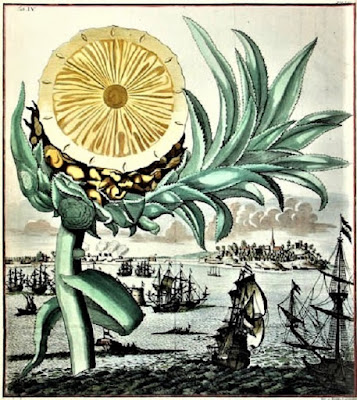
It is remarkable that convict gardener Smith talked with Mary Ambler about pineapples in 1770, & had a treatise on the fruit with him in Maryland. The pineapple’s popularity had grown in England, creating a demand for publications giving directions for its culture. James Justice’s plan for a pineapple stove was published in The Scots Gardeners’ Director, 1754. John Giles (1726-97) published a monograph on the plant in England in 1767. Since the Barrister’s convict gardener arrived in the colonies in 1768, his claim to have written his own treatise is intriguing, because he built a functioning pinery in the British American colonies by the 1770s.
What is the history of pineapple cultivation in Europe & Britain?
A fine article at BuildingConseration.com written by Johanna Lausen-Higgins here surveys the history of pineapple cultivation in England. She writes, "Christopher Columbus first encountered the pineapple in 1493, unleashing a flurry of attempts to convey its exotic flavor to uninitiated Europeans. The superlatives & majestic comparisons continued long after. In a work of 1640, John Parkinson, Royal Botanist to Charles I, described the pineapple as: "Scaly like an Artichoke at the first view, but more like to a cone of the Pine tree, which we call a pineapple for the forme... being so sweete in smell... tasting... as if Wine, Rosewater & Sugar were mixed together." (Theatrum Botanicum)
"Parkinson wrote those words before the pineapple had even reached the shores of Britain. Its introduction to Europe resulted in a veritable mania for growing pineapples & parading them at the dinner table became a fashion requisite of 18th century nobility..
"Pineapples originate from the Orinoco basin in South America, but before their introduction to Europe, the date of which is uncertain, they were distributed throughout the tropics. Later, this led to some confusion about their origin. The Gardener’s Dictionary of 1759 by Philip Miller, for example, gives the origin of the pineapple as Africa...
"European pineapple cultivation was pioneered in the Netherlands. The early success of Dutch growers was a reflection of the trade monopoly the Netherlands enjoyed in the Caribbean in the form of the Dutch West India Company, established in 1621. As a result, plant stock could be imported directly from the West Indies in the form of seeds, suckers & crowns, from which the first plants were propagated...
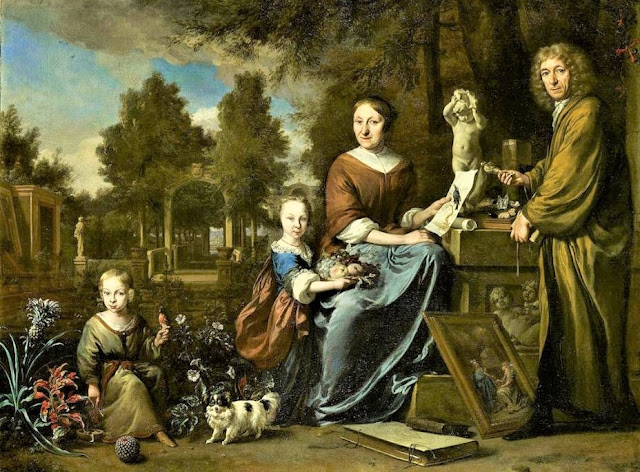
"Dutch methods of pineapple growing became the blueprint for cultivation in Britain, undoubtedly endorsed after the Glorious Revolution of 1688 cemented Anglo-Dutch relations. William Bentinck, close adviser of William III, is thought to have shipped the entire stock of Caspar Fagel’s pineapple plants over to Hampton Court in 1692. The fruits were, however, ripened from this stock of mature plants & therefore did not count as British-grown pineapples. Pineapples had been ripened in this way before, as commemorated in Hendrik Danckerts’ painting of 1675 depicting Charles II being presented with a pineapple by John Rose, gardener to the Duchess of Cleveland. Danckerts’ painting led to the common misconception that Rose was the first to grow a pineapple in Britain.
1670s Hendrick Danckerts (Dutch artist, 1625-1689) Gardener John Rose presenting a pineapple to King Charles II
A continuation of Johanna Lausen-Higgins's article: "The first reliable crop of pineapples in Britain was in fact achieved by a Dutch grower, Henry Telende, gardener to Matthew Decker, at his seat in Richmond between 1714 & 1716. Decker commissioned a painting in 1720 to celebrate this feat & this time the pineapple takes pride of place as the sole object of admiration. From this point on the craze for growing them developed into a full-blown pineapple mania...
"The appearance of innovations seems to follow no clear chronological order. Early attempts at cultivation were made in orangeries, which had been designed to provide frost protection for citrus fruit during the winter months. Orangeries, however, did not provide enough heat & light for the tropical pineapple, which grew all year round. Heating in glasshouses during the mid 17th century was provided by furnaces placed within the structure, but fumes often damaged or killed the plants. Hot-air flues were then devised, which dissipated heat slowly through winding flues built into cavity walls. These "fire walls" were heated by hot air rising from furnaces or stoves & required constant stoking with coal. This was a dangerous method & many early "pineries," as they later became known, burned down when the inevitable accumulation of soot & debris within the flues caught fire...
1720 Theodorus Netscher (Dutch artist, 1661-1732) Pineapple Grown in Matthew Decker's Garden at Richmond, Surrey
A continuation of Johanna Lausen-Higgins's article: "Henry Telende’s method of pineapple cultivation was published in Richard Bradley’s A General Treatise of Husbandry & Gardening in 1721. Telende grew the young plants, called "succession plants," in large cold frames called tan pits. The fruiting plants would subsequently be moved into the stove or hothouse to benefit from the additional heat provided by the hot-air flues.
"The tan pits were lined with pebbles at the bottom followed by a layer of manure & then topped with a layer of tanners’ bark into which the pots were plunged. The last of these elements was the most important. Tanners’ bark (oak bark soaked in water & used in leather tanning) fermented slowly, steadily producing a constant temperature of 25ºC-30ºC for two to three months & a further two if stirred. Manure alone was inferior, in that it heated violently at first but cooled more quickly. Stable bottom heat is essential for pineapple cultivation & tanners’ bark provided the first reliable source...
"James Justice, a principal clerk at the Court of Sessions at Edinburgh, was also a talented amateur gardener. On his estate at Crichton he developed an incredibly efficient glasshouse in which he combined the bark pits for succession & fruiting plants under one roof. (Justice published a very elegant drawing of it in The Scots Gardiners’ Director in 1754.) In a letter to Philip Miller & other members of the Royal Society in 1728, he proudly announces: "I have eight of the Ananas in fine fruit." The letter makes Justice the first documented gardener to have grown pineapples successfully in Scotland...
A continuation of Johanna Lausen-Higgins's article: "An interesting variant growing structure was the pinery-vinery, first proposed by Thomas Hitt in 1757. Here, vines created a canopy for an understorey of pineapples. The vines would have been planted, as was customary in vineries, outside, & fed into the structure through small open arches built into the low brick wall. A fervent admirer of this method was William Speechly, gardener to the third Duke of Portland, & grandson of William Bentinck, who had sent the first batch of pineapples to Britain in 1692. Portland inherited Welbeck Abbey in Nottinghamshire in 1762, & his passion for growing pineapples nearly ruined him. Nevertheless, he sent Speechly to Holland like many before him to study all the latest techniques. Speechly published his now greatly refined methods in A Treatise on the Culture of the Pineapple & the Management of the Hot-house in 1779"...
1775 English Print of James Sibbald, Gardener to Thomas Devlaval, Holding a Pineapple
"Although Philip Miller & John Abercrombie extolled the virtues of tanners’ bark while lamenting the flaws of manure, many structures that used dung as a heating method were devised into the mid 19th century. Adam Taylor wrote a tract titled A Treatise on the Ananas or Pine-apple in 1769 in which the use of horse manure was promoted, probably for the first time, as a method of heating a pineapple pit."
Friday, January 7, 2022
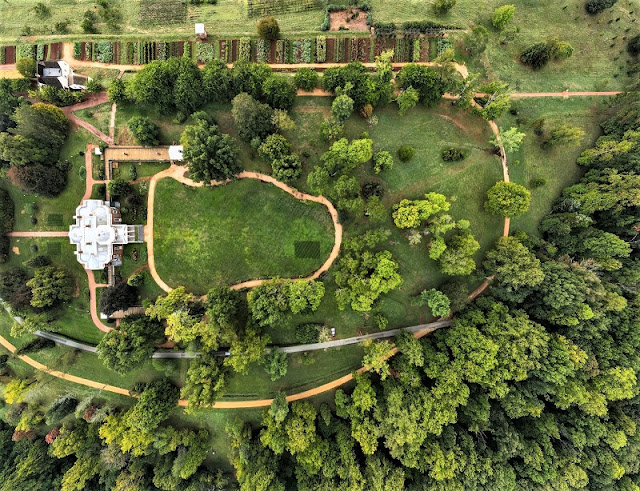
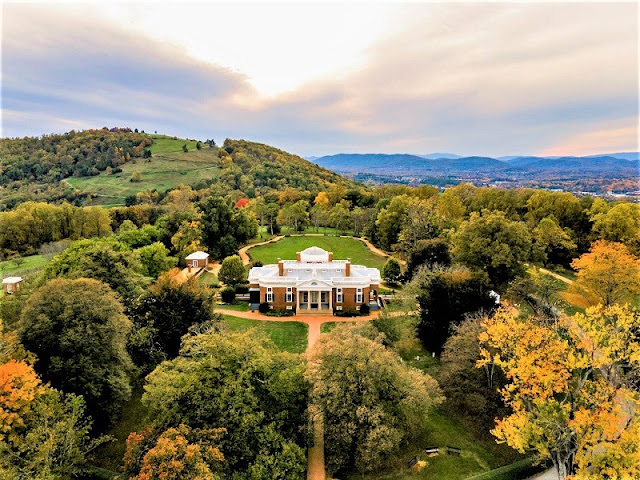
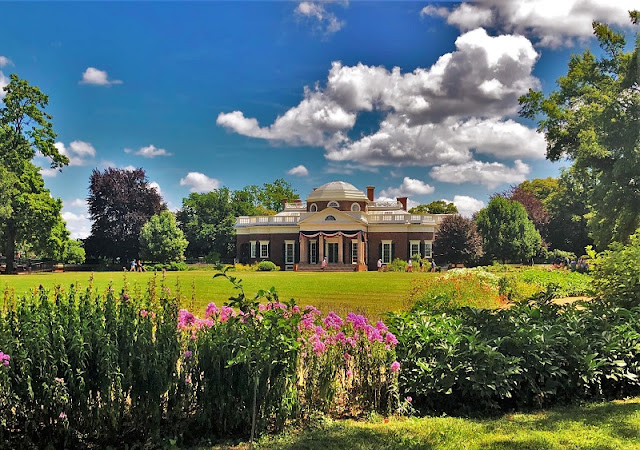
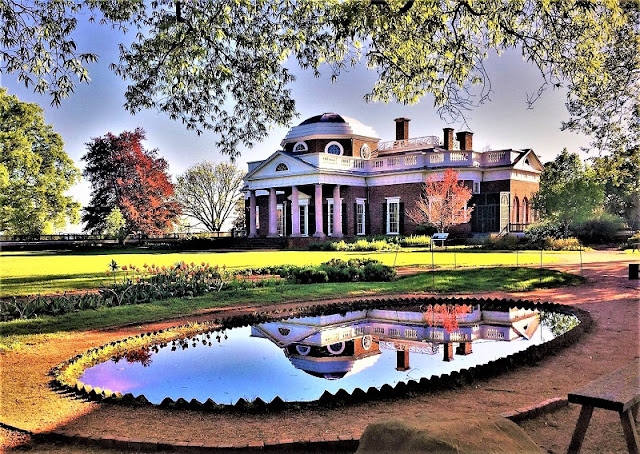
Garden Design - Jefferson's Landscape Vision & The Results - Margaret Bayard Smith's (1778-1844) Visit to 1809 Monticello
“... how sublime to look down into the workhouse of nature, to see her clouds, hail, snow, rain, thunder, all fabricated at our feet!” Jefferson to Maria Cosway in 1786
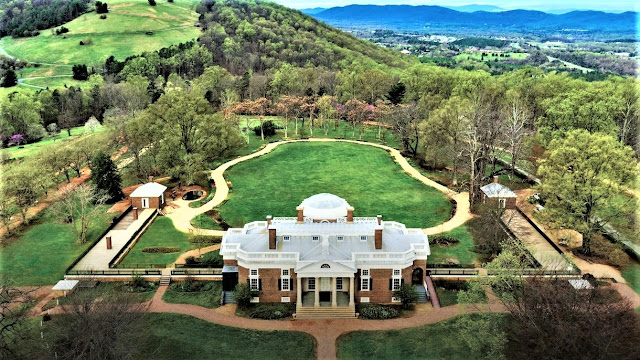
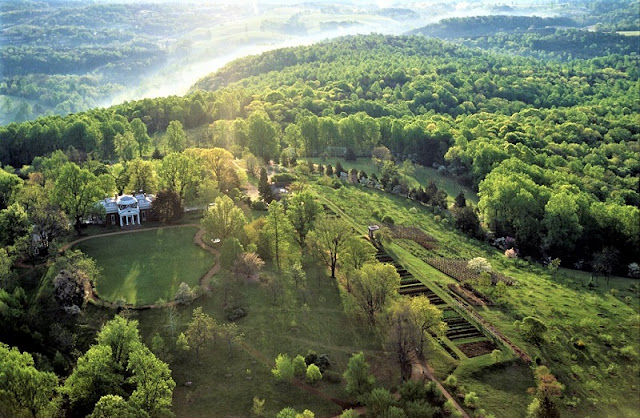
Margaret Bayard Smith (1778-1844) described what she saw on her trip to Monticello in 1809,"Monticello is a small mountain, rising six hundred feet above the surrounding country, on the summit of which is a large edifice, built in the modern style. The base of this small and isolated mountain, which is washed by the Revanna, exceeds a mile in diameter. It is encompassed by four parallel roads, that at equal distances sweep round it, and are so connected with each other by easy descents, as to afford, when completed, a level carriage-way of almost seven miles.
MBS 1809 “On the top is a nearly level plain, of about ten acres, formed by art, in the shape of an ellipsis, with its longest diameter running east and west, corresponding to the two main fronts of the house. The mansion is a structure presenting a front in every direction of a hundred feet in length, and above sixty in depth.
MBS 1809 “The principal front looks to the east, on an open country, and is adorned with a noble portico, with a corresponding one on the west. A lofty dome of twenty-eight feet in diameter, rises from the centre of the building. The north and south fronts present arcades, under which are cool recesses, that open in both cases on a floored terrace, projecting a hundred feet in a straight line, and then another hundred feet at right angles, until terminated by pavilions.
MBS 1809 “This dwelling, and the whole surrounding scene, is eminently fitted to raise an interest beyond that which such objects ordinarily excite in the mind. Every thing, moral and physical, conspires to excite and sustain this sentiment. You stand on the summit of a mountain, on the east affording a view of an open country, presenting a most extensive and variegated prospect; on the west, north, and south, by the Allegany itself, which, rising from beyond the south mountain, rears its majestic head in awful grandeur. Here, in this wild and sequestered retirement, the eye dwells with delight on the triumph of art over nature, rendered the more impressive by the unreclaimed condition of all around.
MBS 1809 “Here it contemplates a spacious and splendid structure, commensurate, in some degree, with the mountain on which it stands; but, above all, it beholds its architect and its owner!
MBS 1809 "On this spot, one, the most illustrious citizen of the only free country on earth—one of the founders of its independence, the advocate of its rights—full of years and of glory, respected for his talents, venerated for his services, beloved for his virtues, withdrawing from accumulating honours, seeks repose in the bosom of his family.
MBS 1809 "On this elevated spot, you behold him reaping the harvest of his virtues, contented, happy; as immoveable as the mountain on which he dwells, and serene as the atmosphere around its brow, while the storm rages at its foot."
Margaret Bayard Smith (1778-1844) by Charles Bird King (1785-1862)
Thursday, January 6, 2022
Seeds & Plants - Shrubs & Bulbs in Tho Jefferson's Greenhouses

Charles Peale Polk (1767-1822), Thomas Jefferson (1743-1826). Thomas Jefferson, who was always experimenting and adding onto his property, was interested in a greenhouse as well. On August 2, 1807, from Albemarle County, Virginia, even Thomas Jefferson (1743-1826) received a letter listing sizes of glass he would need for a "green house."


++from+Metamorphosis.jpg)
++Royal+Gardener+John+Rose+presenting+a+pineappel+to+King+Charles+II+-+Copy.jpg)
+Pineapple+Grown+in+Sir+Matthew+Decker's+Garden+at+Richmond,+Surrey.jpg)